|
|
|
|
Contentsof Course and Notes:
1 The HistoricalJesus.................................................................................................................... 2
Theological; Historical: Deism, Rationalism,Idealism, Romanticism, Skepticism, Present Situation, Jesus Seminar; Summary onLiberal Lives
2 The JewishBackground............................................................................................................ 23
Ancient Sources, Daniel
3 Narratives(Visit of the Wise Men, Matt 2:1-23)...................................................................... 35
Features to Build On, Typical Schedule,Genres, Narrative
4 Authorship& Date of the Synoptics......................................................................................... 41
Authorship, Date, Characteristics
5 Parables (TheMarriage Banquet, Matt 22:1-14)....................................................................... 78
Definitions, How Parables Function: Stories,Analogies, Examples
6 The Gospels asLiterary Works................................................................................................. 84
Literary Form, Techniques
8 The SynopticProblem............................................................................................................... 89
The Problem, Phenomena, Sketch History,Discussion, Proposed Solution
9 The Geographyof Palestine.................................................................................................... 108
Physical Features, Political Features,Jerusalem
10 Miracle Accounts (Demons & Pigs, Mark 5:1-20)................................................................ 118
Genre, Features, Function, List of Miraclesin Gospels
11 The Theology of the Synoptics.............................................................................................. 119
Introduction, Kingdom Characterized, Present,Provisional, Gospel of Kingdom, Kingdom & Church, Future Consummation
12 Form Criticism & Redaction Criticism................................................................................... 127
Form Criticism: Terminology, Background,Methods, Application, Evaluation; Redaction Criticism: Definition, History,Methodology, Results, Evaluation; Conclusions on Gospel History
13 Controversy Accounts (Beelzebub, Luke 11:14-28).............................................................. 158
Narrative or Discourse, Items to Keep inMind, Controversy and Dialogue Accounts in the Synoptics
I.The Historical Jesus
People have enormously diverse views aboutJesus. Some of these are motivatedby their religion or world view, others claim to be honest grappling with thehistorical data. Here we give justa quick tour of influential modern views.
Other religious alternatives divide into twocategories:
- Jesus only human, not God in any real sense;
- Jesus divine in some sense, but not biblicalsense.
The past 200 years have seen numerous attemptsto produce the "real, historical" Jesus who is allegedly quite differentthan the person pictured in the Gospels. These attempts have regularly assumed that miracles do not occur (havingbeen disproved by science), so that the Gospels (filled as they are withmiracles) cannot be reliable. Proponents of such views accept some of the Gospel material and rejectthe rest. We give some exampleshere characteristic of various philosophical movements since just before1800. Albert Schweitzer, in his Questof the Historical Jesus discusses over 100 such liberal biographies of Christ.
Deism sees God as the Creator watchmaker, butone who does not intervene in human affairs.
Hermann Samuel Reimaurus' book was publishedposthumously in fragments; two of these deal w/ Jesus:
- "Concerning the Story of theResurrection"
- "The Aims of Jesus and hisDisciples"
Jesus claimed to be a Jewish‑type Messiah,to bring the Jews back to God, to be a military commander to"deliver" them, but made no attempt to found a new religion.
After Jesus' death, his disciples realized hehad failed. Out of the habit ofworking by this time, they decided to start a new religion.
Publication of Reimaurus' material created asensation, destroyed his reputation, and his family discouraged furtherpublication. Yet it opened the wayfor later liberal reconstructions which were mostly less drastic.
Rationalists think revelation unnecessary becausemoral truth is eternal and can be deduced by good reasoning.
Unlike Reimaurus, Heinrich Paulus wrote a"sympathetic" life of Christ. Jesus was a great moral teacher of unusual insight andability.
Our main interest in Paulus' work is his"rationalistic" treatment of miracles as non-supernaturalevents misunderstood by the disciples as miracles.
His nature miracles are harder to explain, butPaulus suggested that Jesus' walking on water was really on the shore or asandbar; that Jesus used the little boy's loaves and fish to shame the adultsinto sharing their hidden lunches; that Jesus' transfiguration was really thesunrise illuminating his hair and clothes from behind; that the resurrectionsof Lazarus et al was Jesus' recognizing they were in a coma and waking themup.
Jesus' own resurrection was similar. He did notdie on the cross, but went into a coma. The cool tomb and aromatic spices revived him. An earthquake opened the tomb, and Jesus appeared to hisdisciples for a while, but later left them to die. His departure was misunderstood as an ascension, as hewalked up the hill into low clouds.
The importance of Paulus' work was to spreadsuch liberal views into "Christian" circles, claiming sympathy forJesus, but still debunking miracles. Paulus did not lose his job or prestige over the book.
Idealism is used here in the philosophicalsense: ideas are the basic reality rather than matter.
According to David Friedrich Strauss, the entirelife of Christ has been colored by mythological interpretation (not just hisbirth and resurrection as some had suggested). Myth is here defined as timeless religious truth clothed inhistorical form, often by using legendary materials. Thus the religiousideas expressed in the events of Jesus' life are true, but the events did notreally happen. For example,the deity of Christ is not a historical truth, but a myth expressing the"highest idea ever conceived by man: the unity of Godhood andmanhood" (i.e., we are all divine).
In Leben Jesu
Strauss' book met with strong reaction in hisday because it was both anti‑Christian and anti‑rationalistic.
Romanticism a reaction against rationalism'semphasis on reason and logic. Emotions and intuition give insights which you cannot obtainthrough reason.
As Ernest Renan sees it, the Gospel picture ofJesus doesn't make sense [with themiraculous removed]. So he sortsthe materials into three different phases in Jesus' life:
- ethical teacher
- revolutionary
- martyr
Renan claimed that all 3 phases were historical,but they got mixed together chronologically in the gospel accounts.
1) Jesus begins as an optimistic, pleasant ethicalteacher who learned to preach from John the Baptist. He returns to Galilee as a gentle teacher of love, attractsa devoted following of young men and women, plus large crowds of charmed Galileans.
2) When Jesus goes to Jerusalem, he finds therabbis will not accept him. As aresult, he becomes a revolutionary and campaigns to get rid of them.
3) Soon Jesus realizes that his movement doesnot have enough popular support to beat the rabbis, and that he cannot continueto stage miracles indefinitely without being discovered.
His strategy works out better than he expected,as Mary Magdelene has a hallucination that Jesus is alive.
Renan's work is important in spreading liberalreconstructions of Jesus' life to the popular educated classes andparticularly into Catholicism. He opened the door to the idea that reliability can be judged by aesthetics:
Sceptics are doubters to a greater degree thanthe positions above, feeling it is impossible to reconstruct a life ofJesus.
Wilhelm Wrede reacts against reconstructionslike those sketched above, arguing that much in these pictures is obtained by"reading between the lines" and ignoring what Jesus has to say aboutthe second coming, judgment, hell, and such.
Wrede does not attempt a full life of Christ,but tries to solve a single problem: why (if Jesus claimed to be Messiah)did he keep telling people to keep this a secret? Wrede's answer is that Mark invented the Messianic Secretbecause Jesus never claimed to be Messiah but Mark and his circle thought thathe was.
Wrede comes to believe that Mark's wholenarrative framework is unreliable, so that only some of the individual storiesand sayings in his Gospel really happened.
At this point in our narrative of liberal livesof Jesus, notice that liberals have now thrown out all the Gospels: John islate, Matthew and Luke build on Mark, and Mark is unreliable.
This deep scepticism toward the Gospel accountsled to the application of form criticism to the life of Christ by RudolfBultmann and others beginning about 1920, and thereafter brought a stop tothe writing of liberal lives of Christ until about 1950.
Quests for the historical Jesus were resumed inthe 1950's (the so-called second quest) by liberals who were dissatisfied withthe particular form of extreme scepticism advocated by Bultmann.
Renan's observation is correct:
Post-Bultmannian is a term for former studentsof Bultmann, especially:
Gunther Bornkamm
Hans Conzelmann
Klaus Fuchs
Ernst Kasemann
James M. Robinson
Bornkamm is the only one who wrote a life ofChrist, Jesus of Nazareth (1960); the others wrote encyclopedia and journalarticles. All are anti‑supernatural,but feel Bultmann went too far in his scepticism. They have more interest in history than he did, and feelthat the NT material gives us at least the atmosphere of what people thoughtabout Jesus.
Their historical methodology is very skeptical:
Method of Dissonance:
Jesus himself was a Jew and his followers wereChristians. Thus any features of Jesus' reported teachings which lookJewish may go back to the Jews, not to Jesus himself. Any material which looks Christian may go back to the earlyChristians, not to Jesus. Onlythat which is incompatible with both Judaism and Christianityprobably goes back to Jesus. Examine this material to get Jesus' self‑understanding.
Dissonance has problems as a methodology: usingsame on Martin Luther, you would reject any material where he sounds eitherCatholic or Lutheran!
Some Results:
However, these Post-Bultmannians have deducedsome interesting results which do not fit the liberal models well.
(1) Jesus' view of himself.
Kasemann: A very distinct atmosphere is presentin the NT. Jesus thought ofhimself as divinely and uniquely inspired, and that he was greater than aprophet. Jesus made messianicclaims.
Bornkamm and Fuchs: Jesus claimed that he couldforgive sins.
(2) Jesus' teachings.
Kasemann: Jesus' main messages are that God hascome to give men what they don't deserve and to set them free from bondage.
Conzelmann: Jesus spoke of a future
(3) Jesus' conduct.
Bornkamm and Fuchs: Jesus' actions show that heis submitted to God, yet he claims a unique authority (seen in the cleansing ofthe temple). He also showed greatgraciousness to outcasts (contrast Jesus' attitude vs. Pharisees'attitude).
The results seem rather minimal, but they arestriking. They suggest that Jesus is much more than liberals have granted, andthat they should reconsider their scepticism.
Hugh J. Schonfield was a liberal British Jew whoworked on the international Dead Sea Scroll committee.
According to Schonfield, Jesus' ministry is aelaborate plot to fulfill the OT prophecies regarding the Messiah, especiallyhis death and resurrection.
Jesus, convinced he is the Messiah, gathersdisciples, but avoids claiming publicly to be the Messiah for his ownsafety. Eventually, however, Jesusis rejected in Galilee and realizes that he must "die" and riseagain in order to fulfill OT prophecy (Ps.22).
Jesus decides to fake his death rather thantrust God for a resurrection. Heconstructs a plot using several assistants who are only in on parts of theplot. Lazarus' death and resurrectionis faked to build tension with the authorities. The colt is arranged for the triumphal entry, forcingthe Jewish authorities to take action to avoid a revolt.
The plot, almost perfect, is ruined by the spearthrust from the Roman soldier. Jesus is taken down by Joseph of Arimathea and an unnamedconspirator we'll call "Mr.X." That night he is removed from the tomb, taken to another place, revived.
Mr. X tries to tell the women at the tomb; theythink he is an angel. He tries totell some disciples on road to Emmaus; they mistake him for Jesus.
Schonfield's story reflects the influence of thediscovery of Dead Sea Scrolls, with more emphasis on the Messianic expectationat Jesus' time, and renewed appreciation for the Gospel of John as asource. It is peculiar in itsdaring treatment of OT Prophecies. It is a classic example of a plot theory.
A "plot theory" claims that some set ofhistorical events can better be explained C not by the stated or surface motivationsbut C
Plots clearly occur in human history, but plottheories face serious methodological problems:
John Marco Allegro was a professor at Universityof Manchester, England, and another British representative onInternational DSS team. This bookruined his academic reputation!
Allegro has a super plot theory, more radicalthan Bultmann or Schonfield. Jesusnever existed! Christianity andJudaism never existed (in the 1st century)! Their books and teachings are all expressions of code‑wordsused to disguise a super‑secret mushroom fertility cult.
Allegro tries to prove by etymology that the OTand NT are filled with secret codes relating to hallucinogenic mushroomsand sexual orgies. He uses Latin,Greek, Arabic, Persian, Syriac, Hebrew, Aramaic, Sanskrit, Ugaritic, Accadianand Sumerian, enough to snow all but the best linguists.
Morton Smith was Professor of Ancient History atColumbia University; studied in Israel 1941‑45, Ph.D. Hebrew University;Th.D. Harvard.
Smith claims he discovered
Letter answers some charges made by a gnosticgroup called the Carpocratians who had a different version of the Gospel ofMark (included lewd materials used to justify their sexual immorality). Clementsays he has a secret longer version of Mark (not including lewd material) whichthe Carpocratians stole, then corrupted for their libertine group.
Smith sides with the Carpocratians in claimingJesus was really a libertine gnostic magician and that this explains hismiracles, personal claims of deity, secrecy and statements about the law(men are not responsible to the law in any way).
This is not a clumsy
A group of radical NT researchers who have beenmeeting for twenty years or so to produce a scholarly presentation on Jesusthat will blow traditional Christianity out of the water.
Robert W. Funk, Roy W. Hoover, and the JesusSeminar, The Five Gospels: The Search for the Authentic Words of Jesus
Let us sketch where they are coming from andtheir results they obtain (numbers in parentheses are pages in Five Gospels
The seven pillars of scholarly wisdom
1. Jesus of history vs. Christ of faith
2. Jesus of synoptics vs. Jesus of John
3. Priority of Mark
4. Existence of Q
5. Eschatological vs. non-eschatological Jesus
6. Oral culture vs. print culture
Rules of written evidence
Clusteringand contexting
Revisionand commentary
Falseattribution
Difficultsayings
ChristianizingJesus
Rules of oral evidence
Fromthe gospels to Jesus
Oralityand memory
Thestoryteller's license
Distinctivediscourse
Thelaconic sage
The colors in the text
Voting Option 1:
Voting Option 2:
Scoring:
red: 1.00
pink: 0.67
gray: 0.33
black: 0.00
Printing:
red: .7501-1.000
pink: .5001-.7500
gray: .2501-.5000
black: .0000-.2500
Results
An index of red and pink letter sayings liststhe ninety sayings scoring .5 or better, with detailed votes for their variousversions in the different Gospels (549-553).
According to a remark on page 5,"Eighty-two percent of the words ascribed to Jesus in the gospels were notactually spoken by him." Soonly 18% of the words spoken by Jesus in the Gospels are admitted to be his.
In Mark, only one saying is viewed as authentic(red): "Pay the emperor what belongs to the emperor, and God what belongsto God!" (12:17). Not manyeven come in as pink
In John, only one saying even makes it to pink:"A prophet gets no respect on his own turf." (4:44)
The Gospel of Thomas is rated ahead of both ofthese, with several reds and a fair bit of pink, about comparable to Matthewand Luke.
Response
The best book I have seen so far in response tothe work of the Jesus Seminar is Michael J. Wilkins and J. P. Moreland, eds., JesusUnder Fire: Modern ScholarshipReinvents the Historical Jesus (Zondervan, 1995).
Some Specific Responses to Liberal Lives:
This is not a necessary principle to suchreconstructions, but it is currently standard.
-- Later invention
-- Intentional fulfillment
-- Prophecy was vague
-- Fulfillment was misinterpreted
-- Later inventions ("myth") ‑did not actually happen.
-- Staged ("fraud").
-- Misinterpreted natural event (rationalizing).
-- Faith healing (psychosomatic).
Note that whenever some aspect of the data isthrown out, we must explain how itgot there ‑‑ early.
This usually requires the insertion of somesecret plot theory into Jesus' life, or of an unknown genius into earlyChristianity. It presumes that theGospels are basically unreliable.
But if Jesus is the God‑man Messiah, whohas also come to demonstrate what sin is and point it out to people, thenJesus' multi‑faceted personality and actions make sense.
This is the primary issue to which NThistoricity reduces. If miraclescan occur, then the NT gives every evidence of reliable history.
Newman has not seen this in print formally, butit does color liberal arguments.
Note that this argument will not work againstSatanic miracles, since he can certainly sin, commit logical fallacies, and mayeven blunder esthetically!
The logical structure of the argument is sound,but we must examine the content of the propositions.
/1/ Is a miracle necessarily a violation ofnatural law?
However, as /1/ has been used by Christians as acommon (though perhaps notaccurate) definition of a miracle, we should not fault it heavily.
/2/ There is an ambiguity in the term"law".
‑-"sin" implies a moral law.
--"fallacy" implies a logical law.
--"blunder" implies an esthetic law.
But are we justified in mixing moral preceptswith physical constraints? Doesbreaking a physical "law" necessarily imply a moral "sin" has occurred?
Also, are these the only
So /2/ is an incomplete statement,trading on theambiguity of "law".
E.g., God can command us to worship Him (becauseof who He is), but we should not command people to worship us.
Thus the Bible has a precedent for person‑dependentlaws. What is a violation for usmay not be for God, as that law does not apply to Him.
/4/ The deductive argument is not conclusive.
Especially as miracles are connected with God asone of His attributes.
Since we cannot (safely) explore thesupernatural on our own, arguing with revelation about it just leaves us in thedark.
Sometimes people will argue that the Biblicalpicture of God is inferior because it pictures God as needing to"tinker" with his universe. If God were really great, He would have made the natural laws better sothat He would not need to infer with them.
However, this assumes that God desired to createa universe which was fully automatic. Perhaps He desired to create a universe which allowed for His self‑expression.
a) David Hume. His is the most famous and influential.
Hume now shifts from an argument to a program:
Analysis:
Whose "uniform experience" is Humeconsidering? Over what timeperiod? How many individuals is heincluding? To try to use the"uniform experience" of all humanity would not work as some peoplereport that they have seen miracles.
This is true even in modern times.
A more general problem:
Thus the argument must be inadequate since it doesnot include a method to test their possible occurrence.
"Uniform experience" is a poor argument,as there may be a whole realm of reality which we cannot sense and which mustbe revealed to us by revelation (as a deaf or blind person must depend onrevelation for the sense they lack).
We do not need to accept miracles because theyare based on primitive ignorance (p 24):
Andrew Dickson White argues this at great lengthin his History of the Warfare between Science and Theology in Christendom
Problem: The reactions of people in the NT accounts show that they did not expectmiraculous interventions; they were no ho-hum events.
The disciples did not typically expect Jesus towork a miracle to get them out of a jam: e.g., feeding 5000, storm at sea, etc.
NT people always marvel when miracles occur andthey have trouble drawing simple lessons from them.
Harnack argues from reports in secularliterature that miracle accounts were common in the NT period.
We must be careful when deciding what can or cannotoccur on the basis of our preconceptions:
Late 18th century scientists in France andAmerica (including Thomas Jefferson) refused to believe that stones fell fromthe sky, because only peasants and priests reported seeing them.
The "sky does not contain rocks"principle proved to be inaccurate.
This appeals to our pride in hightechnology. Much of our advancedtechnology does look miraculous to "primitives" (radio,telephone, computers, etc.).
However, can we now explain away Jesus' miraclesby means of high technology? (Walking on water? raising dead?).
NT people knew which diseases did not healsuddenly (blindness, death,leprosy, crippled limbs, etc.).
People today still cannot explain these miracleswith technology.
Consider Mark 6:47‑52 - walking on water
7:31-37 - deaf & mute healed
8:1-20 - feeding 4000
It is impressive that Jesus did just those typesof miracles which still stump us in the 20th century!
Many historians and scientists are scared ofmiracle because they think that then the whole bottom drops out of theirwork: "My job is to explainreality, and this would introduce a whole new realm."
Scientific historians feel there should be nomiraculous interventions needed to explain history.
Adding miracles does add a new dimension toreality for many people.
History has thus been "explained"without miracles. But we don'tknow if these explanations are true since we can't check them.
If there is a God who intervenes, then historywill be affected on a large scale.
God and other supernatural beings introduce thepossibilities of new purposes and goals.
May be points in history when miracles werehappening but they were not important historically.
Regeneration is miraculous and does effecthistory.
There may be points in history where miraclesare extremely important for understanding the events.
There already are plenty of difficult‑to‑assessvariables in understanding history: Individual personalities, backgrounds,motivations, economics, etc.
We do not have to evoke a miracle whenever anevent occurs which we cannot explain.
Some people object that miracles add anirrational element to history. Bythis they mean it adds an element which they can not predict what it will do.
This destroys the historian's dream of beingable to predict the future.
The Christian realizes that something irrationalis notbeing added. Another mind isinvolved, but God's mind islogical and rational.
Through revelation, God explains what He isdoing in His miracles before and/or after the event.
Satan may or may not tell what he is doing.
Sin and sinful minds are irrational, but God isnot.
Thus Satanic miracles may be irrational, but indealing with the motivations of (sinful) humans, we already have plenty of theirrational in history.
Note the parallel activities of God and man.
Miracles reveal an unseen supernatural person,just as human activity reveals the unseen inner man.
There is already an [irrational] hidden elementin history since man and his motivations can not be mathematicallyexplained or absolutely foreseen.
Miracles are not the only item that keepshistorians from being able to predict the future: People also mess them up.
Liberals have not been able to make sense ofJesus without miracles.
With miracles, Jesus and rest of Scripture makessense:
1) They are Satan's work.
see C.S. Lewis, Screwtape Letters
Screwtape describes how to keep peopledistracted from the real Jesus: Have them search for the "historicalJesus" and write a new life of Jesus every year.
Such work is called "brillant" inliterary circles, but is based on the type of guesswork which would beruinous in business, betting on horses, etc.
This distraction from the real Jesus is a modernform of idolatry, since they make up their own Jesus.
2) Why does God permit this?
Deut. 13:1‑5 discusses why the LORD wouldallow false prophets to arise (parallel to liberals):
Test for people to see if they love the God whoexists in comparison with gods of human invention who often look moreattractive, or more tolerant of their sin.
The world (and its history) is a testing groundto demonstrate that humans are as bad as God says they are and that only Hismercy can save us.
Anice discussion of the reality of miracles from an evangelical perspective isgiven in R. Douglas Geivett and Gary R. Habermas, eds.
II.Jewish Background to the New Testament
To understand the New Testament, especially theGospels, it is helpful to know a good deal about the Old Testament. It is also helpful to know something of what went on during the fourcenturies that separate the end of the OT narrative from the beginning of theNT narrative. It is this latter wewish to look at here, called in Christian circles
A.Ancient Sources of Information on the InterTestament Period
Daniel gives an overview of the period and somedetails
Give insight into culture, religious ideas,sects, biblical interpretation during period
Shows partial accommodation to Hellenism
Jew who was involved on both sides of Jewish war66‑73
Wrote Jewish War
Literature written/copied by Qumran sect(probably some sort of Essenes)
Oral traditions of rabbis
Midrash, Mishnah, Talmuds
B.Daniel's Overview of the Period
a. Image pictured (vv 32‑35)
(0) Statue & action
(1) Head of Gold (32)
(2) Breast & Arms of Silver (32)
(3) Belly & Sides of Bronze (32)
(4) Legs of Iron (33)
(5) Feet, part Iron, part Clay (33)
(6) Stone smashes image, grows to fill earth (34‑35)
b. Image explained (vv 38‑45)
(0) What will happen hereafter (45)
(1) Nebuchadnezzar's universal rule (38)
(2) Another kingdom inferior [?] to Neb's (39)
(3) 3rd kingdom to rule over all the earth (39)
(4) 4th kingdom strong as iron, breaking (40)
(5) The same [?], part strong, part broken (41‑43)
(6) God will set up a permanent kingdom (44)
a. Animals pictured (3-14, more details in 19,21-23)
(0) Diverse beasts from sea (3)
(1) lion w/ eagle's wings; plucked, lifted,heart (4)
(2) bear raised on one side; 3 ribs in mouth (5)
(3) leopard, 4 wings, 4 heads (6)
(5) 4th destroyed, dominion given to son of man(9-14)
b. Animals explained (17-26)
(0‑4) 4 kings who will arise from earth(17)
(5) Saints take kingdom & possess it forever(18)
| The Kingdoms | The Image (Dan 2) | The Beasts (Dan 7) |
| Babylon: 609-539 BC | Gold Head | Lion w/ wings |
| Medo-Persia: 539-331 BC | Silver Arms & Breast | Bear eating ribs |
| Greece: 331-30 BC | Bronze Abdomen | Leopard w/ 4 heads |
| Rome: 30 BC- 476 AD | Iron Legs | Terrible 10-horned |
C.Palestine under Persia (539‑331 BC)
Cyrus (559) inherits small kingdom of Anshan(Persia)
Cyrus defeats Medes (550); Nabonidus cancelssupport!
Cyrus takes Asia Minor (546), then Babylon (539)
Cyrus tries to avoid offending other religions
Ends deportation policy, so Jews can return(Ezra 1:2‑4)
Nehemiah (445) sent by Persian king as governorto rebuild walls
a. Old Language of Syria (upper Euphrates)
b. Becomes Diplomatic Language of the AncientNear East
c. Adopted by the Jews
apparently during Babylonian exile (see Neh 8:7‑8)
oral translations of OT called Targums
still in use at time of Christ
used in rabbinic Talmud, c550 AD
place of worship for those unable to attendtemple
features prayer & Bible study but nosacrifice
date of origin obscure
continued alongside 2nd temple (515 BC ‑AD 70)
only place of Jewish worship after destructionof 2nd temple
orthodox, continuation of Mosaic regulations
Samaritans, w/ help from renegade priests
destroyed by Hasmoneans (Maccabees)
still a holy site in NT times (see John 4:20)& today
Jewish mercenaries lived here, possibly refugeesfrom Manasseh
polytheistic? cp Jer 44:15‑19: "Queenof Heaven"
built in Maccabean period by refugee high priestOnias 3
destroyed by Romans after Jewish War
D.Palestine under the Greeks (331‑c160 BC)
succeeds assassinated father Philip at age 20(336 BC)
invades Asia Minor (334) w/ 35,000 men
victories at
Granicus River (334) - opens Asia Minor
Issus (333) - opens Syria, Palestine, Egypt
Gaugamela (331) - destroys Persian empire
continues eastward to India, turning back atdemand of his soldiers
dies in Babylon at age 33
his agenda includes mixing East & West;Hellenism, spread of Greek language
Alex's son still baby at Alex's death; Alex
generals keeping throne for son fall to fighting
eventually empire broken into several pieces:usually counted as four
Lysimachus ruling Thrace
Cassander ruling Macedonia
Seleucus ruling Asia Minor, Mesopotamia
Ptolemy ruling Egypt & Syria
only latter two important for Jewish background
Ptolemy grabbed off Palestine while othersdefeating Antigonus
reasonably favorable treatment of Jews both inPalestine, Egypt
(a large number settle in Alexandria)
in long series of wars finally got Palestinefrom Ptolemies
Ant 4 later attempts to abolish Judaism (168),leading to Maccabean revolt (167)
From Greek word for Greece,
name for Greek culture as it developed in Eastafter Alexander
influenced Judaism and somewhat influenced by it
includes religious mixing (syncretism)
various schools of philosophy
(Epicurean, Stoic, Platonic)
political benefits of citizenship
a. Origin of the Version (c250 BC)
later additions to story:
translation covers whole OT;
identical translations produced by translatorsworking in pairs
general opinion of story today
translation into Greek made at Alexandria
Pentateuch translated as a unit about 250 BC
scrolls from Jerusalem (possibly translators,too)
Ptolemy 2 allowed work, may have given aid
b. Importance of Version
E.Jewish Independence under the Hasmoneans (160‑63 BC)
usurps throne from under-age nephew (175 BC)
tries to unify diverse empire via Hellenism
a.Origin
Mattathias & 5 sons call for armed resistance, flee to mountains
b. Judah the Maccabee (166‑160 BC)
3rd son of Matt, military nickname"hammer" or "hammerer"
JM's forces grow w/ success, matching Seleucidescalation of forces
JM, heavily outnumbered, killed in battle (160)
surviving brothers of Judah
a.John Hyrcanus (134‑104 BC)
greatly expands Judean territory:
coastal cities, Idumea, Samaria
rise of Pharisees & Sadducees
b.Aristobolus (103 BC)
c.Alexander Jannaeus (102‑76 BC)
d.Salome Alexandria (75‑67 BC)
wife of Arist & Alex J, succeeds at AJ'sdeath
2 sons: Hyrcanus 2 ‑ made high priest
Aristobolus 2 ‑ given military command
e.End of Hasmonean Independence (66‑63 BC)
H2 flees, opens civil war, calls on Romans forhelp
theology:
| Essenes | Pharisees | Sadducees |
| hasid - faithful | parash - separate | tsedek - righteous |
| super Pharisees, abandoned temple | ritual purity, hedge around Law | more pragmatic, compromising |
| Calvinistic | Calvinistic | Arminian |
| OT + secret books | OT + oral tradition | OT only |
| Immortal souls? | Resurrected bodies | No survival |
| Emphasis on angels | Belief in angels | No angels |
| Emphasis on eschatology. | Last judgment | No judgment |
influence & survival:
| Few, withdrawn | Popular, not large | Few richest |
| Withdrawn from politics | Dominant religiously | Dominant politically |
| Wrote or copied Dead Sea Scrolls | Rabbinic literature by heirs | No known writings survive |
| Qumran destroyed 68, some survived | Survive AD 70 to dominate Judaism | Destroyed w/ temple |
F.Palestine under the Romans (63 BC‑135 AD & beyond)
1. The End of the Hasmonean Dynasty (63 BC)
Romans intervene in dispute between H2 and A2
Judaea loses much of its conquered territories
2. The Pax Romana
2 centuries of peace over Roman Empire beginningw/ Augustus
Great growth in prosperity, reaches peak in 2ndcen AD
Pax Romana important for early spread ofChristianity
Other features important for spread of Xy:
-- Roman roads
-- lack of national boundaries
3. The Herod Family
a. Antipater, Herod's father
Idumean advisor to Hyrcanus 2, power behindthrone
Made Procurator of Judea for aiding JuliusCaesar
Made own sons Phasael & Herod administrators
Assassinated 43 BC
b. Herod the Great (37‑4 BC)
Appointed joint tetrarch w/ brother Phasael (42)
Brother killed by Parthians invading, Herodflees to Rome (40)
Senate appoints him King of Jews (40)
Herod returns with army, takes Jerusalem (37)
Throne insecure til Anthony & Cleopatradie (31)
kills favorite wife, Mariamne, 3 sons, etc.
His Accomplishments:
ruled large territory
refurbishes Jerusalem Temple (19 BC‑66 AD)
building projects @ Caesarea, Sebaste, etc.
killing of the Bethlehem's children
c. Herod's Sons ‑ ruled by his will atdeath
Archelaus ‑ Judea/Samaria/Idumea (to AD 6)
Antipas ‑ Galilee/Peraea (to 39)
Philip ‑ Iturea/Trachonitis (to 34)
d. Herod's Descendants ‑ by Mariamne(royal blood)
Herod Agrippa 1 ‑ King of Jews, AD 41‑44
Herod Agrippa 2 ‑ King (but not of Jews)dies about AD 100
G.Messianic Expectation at the End of the I.T. Period
1. Messianic Fervor
strong in 1st cen AD, infl in Jewish revolt
(see my "Time of the Messiah," Evidenceof Prophecy)
2. The Person of the Messiah
Views change w/ time:
later rabbinic material tends to minimizeMessiah
3. Various Views of the Messianic Period
a. Messianic period only (Millennium, on earth)
b. Eschaton only (Eternal State, heaven orparadise)
c. Both Messianic period and Eschaton (M.P. 1st,naturally)
most common

a. Signs preceding end
moral decay, calamities, signs in heaven,forerunner
b. Messianic kingdom established
Return of Israel from exile
Punishment of nations
Messiah Rules (role in conquest varies)
c. The Days of the Messiah("Millennium" in Christian theology)
Length uncertain (40 yr to over 1000)
Ends w/ rebellion of Gog & Magog
d. The Age to Come ("Eternal State" inXn theol)
Resurrection
Judgment
Eternal state of punishment/reward
H.The End of the Jewish State
1. The Roman Procurators (AD 6‑66)
2. The (First) Jewish Revolt (AD 66‑73)
I.Palestine after the Fall of Jerusalem (AD 70‑135)
1. Rabbi Johanan ben Zakkai & Jamnia
Johanan escaped besieged Jerusalem in coffin
got permission from Romans to establishrabbinical school and Sanhedrin at
2. The Bar‑Kochba (Second) Revolt (AD 132‑35)
Revolt at 1st successful, w/ Roman troops spreadthin
eventually put down w/ considerable slaughter
Jews forbidden to come near Jerusalem (Aelia)
Judaism ceases to be a missionary religion
J.Materials for Researching Jewish Backgrounds of NT
1. Commentaries:
Those commentators which put some effort intothis often have good material. Itis easily organized by the passage you are studying, but be sure to look atparallel passages in the other Gospels.
2. Bible Encyclopedias:
These will be alphabetical by topic, which isgreat if you know what topic to look under! Most have subject indices with more categories than articlesat the end (EJ at beginning), but still may not know what Jewish term touse to study a subject which has a different name in Christian circles (e.g.,baptism, look under mikva or tevilah).
3. Specialized Works:
Dictionary of NT Background
4. Primary Sources:
You should try to read Josephus (at least)sometime early in your exegetical career.
III.Introduction to Exegesis
Here we provide a quick sketch of things tothink about in doing exegesis. Amore thorough presentation of exegesis will be found in the course NT 650Advanced Greek. Two helpful booksrelating to biblical exegesis are: Dan McCartney and Charles Clayton, Letthe Reader Understand(Bridgepoint, 1994) and Robert Stein, A Basic Guide to Interpreting theBible(Baker, 1997).
A.Some Features We Need to Continually Build
Exegesis is not simply a mechanical process, inwhich you learn a few rules and just apply them without thinking.
1. English (or your native language) BibleKnowledge
The more you know the rest of the Bible, thebetter you will understand the particular passage you are working on.
The advent of computer Bibles has made it easierto find all other occurrences of particular English (Greek, Hebrew) wordselsewhere in Scripture, but this doesn't guarantee you'll find all the passagesthat are relevant to the one you're working on. Even cross-reference Bibles and topical concordances won'tguarantee this, though they can be very helpful.
One important item to keep working on the restof your life is your knowledge of the Bible in your native orheart-language. To help myselfwith this, I try to read through the Bible once a year, and have done so for 25years or so. The OT has 929chapters, the NT has 260, for a total of 1189. To get through the Bible in a year, you need to read severalchapters per day. To be exact, toget through just once in a year, you must read 3.26 chapters/day (approx 3/daywith 5 on Sundays). If you read 4chapters/day, you can get through the OT once and the NT twice.
2. Biblical Language Competency
Even after you have put in the (considerable)effort to learn Greek and/or Hebrew, much of this stuff will evaporate if youdon't use it. I suggest that youtry to put in some time each day (or at least each week) working with one orboth of the original languages, even if it is as little as translating only oneverse! Tom Taylor recommends adevotional book Light for the Path that provides a short passage from theGreek NT and a verse or so from the Hebrew Bible for each day.
3. Bible Background
If you are serving the Lord in any capacitywhich involves study of the Scriptures (preaching, teaching, home Bible study,etc.), you will need to spend time working through the particular passage forthe next sermon, session, etc. This special study for specific passages should get you into thecommentaries, and perhaps Bible encyclopedias and such, so that you will getsome exposure to the historical, cultural background of that particularpassage.
[I should say here that you need to berealistic. Don't overkill on theamount of preparation you do and then give up after a few weeks.
An important facet you need to develop for yourknowledge of Bible background will probably not come through working onspecific passages. You need to getsome kind of overview C
For some years, I kept a list of all the books Ihad read since about 1968. Thisamounted to over 50 books per year (over 100 for six of these years), andusually over 50 in the broad area of religion. I have read primary sources such as Josephus, the Dead SeaScrolls, OT and NT Apocrypha, the Nag Hammadi gnostic texts, some of therabbinic literature, and am currently hung up part-way through Philo(!). I have read works on ancienthistory, encyclopedias of the ancient Greek and Roman worlds, books oneveryday life in Rome, ancient Greek warfare, archeology, and such.
If you are a pastor or counselor, you willobviously need to put some of your reading effort into books specificallyrelated to these areas, but you should not neglect reading that will strengthenyour understanding of the biblical world.
4. Spiritual Insight
Just as Paul said that the most spectaculargifts are worthless without love (1 Cor 13:1-3), so the most complete setof mental and bibliographic tools for exegesis will be counterproductivewithout real spiritual life and insight. If we don't know Jesus, all our exegetical skills will onlyadd to our condemnation in the end. If we know Jesus, then we will grow in spiritual insight as we gainexperience through our own problems, and through helping others withtheirs. It is absolutely crucialthat we have a close communion and love for Lord to do good exegesis.
B.Typical schedule of exegesis sessions
We will normally have three 50-minute sessionsfor each week featuring exegesis. We will divide these into three pieces, though not necessarily of 50minutes each.
1. Genre discussion
2. Translation
3. Verse-by-verse, with discussion of worksheet
Since all these sessions occur on the same dayin our current block-scheduling system, you need to have your translation,commentary reading, and worksheet done when you come to class on these exegesisdays.
C.Genres in the Synoptic Gospels
Etymologically, the term "genre" ismerely a French word for "kind." It has become a technical term in literary studies for akind of literature, writing or speaking. It may be as broad as the distinction between prose and poetry; it maybe as narrow as a particular kind of specialized poem such as the limerick, orthe little stories we call parables. To be recognizable, a genre must have some list of features thatdistinguish it from other genres. We will look at several genres common to the Synoptic Gospels in theweeks of this course.
Class exercise: What are some of the features of: poetry?
a sermon?
a pun?
Genres covered in class exegesis: TP = termpaper passage
1. Narrative:
Visit of Wise Men (Matt 2:1-23)
2. Miracle Account:
Gadarene Demoniac (Mark 5:1-20)
3. Parable:
Royal Wedding Feast (Matt 22:1-14)
4. Controversy Account:
Casting out Demons by Beelzebub (Luke 11:14-28)
Genres not covered in class:
5. Discourse:
TP: Do Not Worry (Matt 6:25-34)
Washing Feet (John 13:1-9)
7. Genealogy:
Matt 1:1-17
8. Dialogue:
Temptation (Luke 4:1-13)
D.The Narrative Genre.
1. Definition
A narrative, very briefly, is a story, account,or tale of events. It may beeither factual or fictional, though I understand all biblical narratives to befactual unless somehow marked. Forexample, narratives in parables are probably fictional; Jotham's narrativeof the trees electing a leader (Judg 9:8-15) is presumably (!) fictional.
Narrative is a very broad genre, usually asubclass under prose, though poetic narratives do exist in literature(e.g., the Song of Deborah and Barak, Judg 5; Homer’s Iliad
2. Components of Narrative
a. Actors/Characters
The persons who appear in the narrative, causingthe events narrated, or affected by them.
b. Events/Action
Occurrences described by the narrative.
c. Scenes
Where the events occur: time, country, region,town, indoors or out, etc.
d. Plot
The interconnection and development of theevents in a narrative. A complexnarrative may have more than one plot, with the various plots interwoven insome way or other. The plotitself, often a conflict of some sort, may be subdivided into sections where,for example, tension is building, the climax is reached, the conflictis resolved, tension is released, etc.
E.Types of Narrative within the Gospels
Leland Ryken, in Words of Life:
1. Annunciation/Nativity Stories
Narratives of events surrounding the birth ofJesus. Emphasis on uniquenessof Jesus, historical validity, supernatural occurrences, fulfilment ofprophecy, excitement, etc.
2. Calling/Vocation Stories
Narratives of Jesus' calling people.
3. Recognition Stories
Narratives of people discovering who Jesusis. What were the circumstanceswhich led to recognition, what did the person come to recognize about Jesus?
4. Witness Stories
Jesus or another character testifies who Jesusis or what he has done, and what the evidence is for this.
5. Encounter Stories
Representative stories of how Jesus seeksothers. They begin with his ortheir initiative, continue with Jesus making some claim on their lives, endwith their response, either acceptance or rejection.
6. Conflict/Controversy Stories
Most common in Gospels, pitting Jesus asprotagonist against an opposing person or group (antagonist).
7. Pronouncement Stories (in Form Criticism,Apothegm Stories)
An event is linked with a notable saying byJesus. How do the story and sayinginterrelate?
8. Miracle Stories
We discuss this later under the genre"Miracle Story," Ryken suggests typical structure as follows:
a. Need is established
b. Jesus' help sought
c. Person in need (or helper) expressesfaith/obedience
d. Jesus performs a miracle
e. Characters respond to miracle/Jesus
9. Passion Stories
Narratives of events surrounding the trial,death and resurrection of Jesus. Can be viewed as whole section for each Gospel, or subdivided intoseparate stories.
10. Hybrid Stories
Narratives which combine elements of the above,e.g., miracle stories which produce recognition, pronouncement storieswhich are also encounters, etc.
IV.Authorship and Date of the Synoptic Gospels
We here sketch the historical evidence for theSynoptic Gospels being written by their traditional authors Matthew, Mark, andLuke, and all before AD 70. Wesuggest that Matthew was written first (also traditional), that the order ofMark and Luke is uncertain (traditionally Mark is next), though we favor Lukein the late 50s and Mark in the early 60s, shortly after Matthew was translatedinto Greek.
A.Authorship of the Synoptics
We will take each Gospel in turn, following thetraditional order of the NT canon, citing first internal evidence of authorship(which is rather skimpy) and then external, citing the major quotations infull.
a. Internal Evidence
Except for the title (and we never have a copyof Matthew with any other person listed in the title), the text is anonymous(i.e., the writer never indicates when he is alluding to himself in anidentifiable manner). We do notknow if the title was put on the autograph by the author or not.
Given that Matthew wrote it, is interesting thatin his apostle list (Matt. 10:2‑4)he calls himself a tax collector, not exactly a popular profession in NTPalestine! Mark, Luke and Actsomit this detail from their apostle lists. This suggests the humility of Matthew and a probable reasonfor all the Gospels being anonymous, to keep the focus on Jesus.
b. External Evidence
1) Papias (writing c130 AD)
Then Matthew wrote the oracles (τ
Expositionof the Oracles of the Lord,
citedin Eusebius Church History 3.39.16
The original of Papias' Exposition
What is meant here by "theoracles": Was this theGospel? Liberals who hold to theTwo Document Theory (see our later discussion of the Synoptic Problem) oftensay that "the oracles" were the Q source.
However, Papias later uses "oracle" torefer to Mark, and everyone agrees he is referring to the Gospel there.
What is meant by "Hebrewdialect"? This could refer toeither Hebrew or Aramaic language, as both are sometimes called"Hebrew" in antiquity. This would imply that the original of Matthew was in Hebrew or Aramaic,and it was translated later.
In opposition to the above idea, some take"dialect" to mean "Greek written in a Hebraisticstyle." This theory does notfit Papias' comment as well, as it is hard to see how a simple stylisticdifference would make Matthew so difficult to interpret.
Recently, George Howard at the University ofGeorgia has argued that a rather poorly preserved text of the original Hebrewof Matthew has come down to us in a medieval Jewish polemical (anti-Christian)text Even Bohan;see George Howard, The Gospel of Matthew according to a Primitive HebrewText(Mercer Univ Press, 1987).
2) Irenaeus (c180 AD)
Now Matthew published also a book of theGospel among the Hebrews in their own dialect, while Peter and Paul werepreaching the Gospel in Rome and founding the Church
AgainstHeresies3.1.2 (Latin);
Greekin Eusebius Church History 5.8.2.
Note that Irenaeus calls Matthew's work aGospel, in the Hebrew dialect, and gives it a date
3) Pantaenus (c.180 AD)
Eusebius,Church History5.10.3
Pantaenus was a Christian from Alexandria,Egypt, who was head of the catechetical school there before Clement and Origen.
Notice that this is indirect information:"The story goes that ..." Pantaenus notes that Matthew was written in "Hebrew letters"(could still be either Aramaic or Hebrew, but not Greek).
The remark about India is not far‑fetched;there was travel between India and the Roman world at this time.
4) Clement of Alexandria (c200 AD)
Head of catechetical school afterPantaenus. Left Alexandria duringpersecution in 203, died 210-217 AD.
Again in the same books Clement gives atradition of the early presbyters concerning the order of the Gospels inthe following manner: He said that those Gospels which contain the genealogieswere written first; but the Gospel according to Mark had this occasion...
Outlines
By "tradition of the presbyters,"Clement means information he haslearned from leaders before him.
Explicitly states that Matthew and Luke werewritten first, so before Mark.
5) Origen (c240)
Clement's successor in Egypt; later went toCaesarea, where he built up alarge library inherited eventually by Eusebius.
In the first of the books on theGospel according to Matthew,observing the ecclesiastical canon, he testifies that he knows only fourGospels, writing somewhat as follows: As he has learned by tradition concerning the four Gospels,which alone are undisputed in the Church of God under heaven, that first therewas written the Gospel according to Matthew, the one‑time publican butafterwards an apostle of Jesus Christ, who published it in the Hebrewlanguage (γράμμασιv) for those fromJudaism who believed.
Commentaryon Matthew:cited in
Eusebius,Church History6.25.3
Order: is Origen giving chronological orcanonical order here?
Language = letters. This is clearer than saying "dialect."
The next two witnesses are important more fortheir access to written documents which have not survived, than for theirlikely access to reliable oral tradition. Eusebius is the major historian of the ancient church, Jerome one of itsbest scholars.
6) Eusebius of Caesarea (c325)
Bishop of Caesarea after the end of Romanpersecution, with access to the same library as Origen.
Yet of all the disciples of the Lord, onlyMatthew and John have left usmemoirs; and they, it is reported, had recourse to writing only under pressureof necessity. For Matthew, whopreached earlier to Hebrews, when he was about to go to others also, committinghis Gospel to writing in his native tongue, compensated by his writing for theloss of his presence to those from whom he was sent away.
Eusebius,Church History3.24.5‑6
"Memoirs" - an ancient genre forfamous people thinking back over events in their own lives.
7) Jerome (c400)
Matthew who is also called Levi, and whochanged from a publican to anApostle, was the first one in Judaea to write a Gospel of Christ in Hebrew letters and words for those from thecircumcision who believed; who translated it afterwards into Greek is notsufficiently certain.
Jerome,Lives of Illustrious Men 3
c. Summary on Authorship of Matthew
This is consistent with title and content of thefirst Gospel. No other names areassociated with it. The earlychurch knew of fake gospels and rejected them.
This is frequently disputed today, as mostliberals (and many conservatives) think Matthew's Gospel uses Mark's.
This, too, is often disputed today because theextant Greek Gospel does not look like translation‑Greek from a Semiticlanguage. [Translation-Greek:
But it could be that the translator tried togive it a more fluent Greek style. Some OT translations into Greek were concerned about style: e.g.
Symmachus and Theodotion ‑ good Greekstyle;
contrast Aquila ‑ very literal translationGreek.
In English, the NASB is something liketranslation-English, the NIV has a good English style.
Perhaps Matthew himself made a free translationat a later time. We don't know forsure if it was a translation, or (if so) who made it.
Effect on inspiration if it is atranslation: No problem if Matthewtranslated it. More a concern ifdone by someone besides an apostle or a trusted associate (Luke, etc.).
What languages were used in Palestine in NTtimes? Hebrew, Aramaic, and Greekwere all used in Bar-Kochba materials which we have been found recently incaves. Latin, Greek, and Hebrew(or Aramaic) were used in the signover the cross. Don't know howmany people were multi‑lingual. Since several of Jesus' NT statements are in transliterated Aramaic,this was probably Jesus' native language.
a. Internal evidence
Like Matthew, except for book title, Mark isanonymous in its text.
Some have suggested the style seems to fit thepersonality of Peter:
1) impressionable rather than reflective.
2) emotional rather than logical.
3) many vivid details, including:
The outline of Mark is close to that of Peter'stalk at Cornelius' house (Acts 10:37‑41). Both start with John's baptism rather than Jesus' birth orpre-existence (like the other gospels).
The standpoint of narrative is consistent withPeter as author. By
Mark 14:51 (young man who loses his sheet atarrest of Jesus) makes best sense as a brief sketch of Mark himself.
b. External Evidence for Authorship of Mark
1) Papias (c130 AD)
And this the Presbyter [apostle John?] usedto say: Mark, indeed, since he was the interpreter of Peter, wrote accurately,but not in order the things either said or done by the Lord as much as he[Peter? Mark?] remembered. [*] For he neither heard the Lord nor followed him,but afterwards, as I have said [heard and followed] Peter, who fitted hisdiscourses to the needs [of his hearers] but not as if making a narrative ofthe Lord's sayings; consequently, Mark, writing some things just as heremembered, erred in nothing; for he was careful of one thing
Expositionof the Oracles of the Lord;
citedin Eusebuis, Church History 3.39.15
This is the most complete statement from Papiasregarding any Gospel. The bracketsare either explanatory material added by translators to clarify his statementor my comments.
Papias is citing information which goes backbefore him. The"Presbyter" (elder) is most likely the author of 2 and 3 John
Note the problem as to where the quotation fromJohn ends. It probably ended asearly as [*], since the next sentence is in the 1st person (Papias?).
Mark as the "interpreter ofPeter": Might refer to a
"Accurately, but not in order..." isstrange, since many feel that the chronology/order of events in Mark isquite good. This might, however,refer to Mark's original note‑taking: i.e., Peter did not give the data in chronological order but"fitted it to the needs of his hearers" as he gave messages invarious Christian churches. Inthis case, Mark's compilation is in order, but the data as given him by Peterwas not in order.
"As much as he remembered..." alsoprobably refers to Peter, notMark.
"Accurate" (first occurrence) iswithin the direct quote from John.
Probably Papias is following rabbinic usagehere: The student memorizes (exactly) a teacher's statement (the Mishnah
2) Justin Martyr (c140-50 AD)
After speaking several times of the memoirs ofthe apostles called Gospels, and having just mentioned Peter, Justin says:
Dialoguewith Trypho106.
The assumption that "his memoirs"refers to Peter as author and not to Christ as subject is reasonable sinceJustin never elsewhere refers to "Christ's memoirs" but always to"the memoirs of the Apostles".
3) Irenaeus (c180 AD)
Matthew published ... while Peter and Paulwere preaching the Gospel in Rome and founding the church.
AgainstHeresies3.1.2 (Latin);
Greekin Eusebius, Church History 5.8.2
"Departure" could refer to death(figuratively) or to leaving Rome alive (literally); both constructions arecommon.
4) Clement of Alexandria (c200 AD)
... the Gospel according to Mark had thisoccasion: When Peter had preached the word publicly in Rome and had declaredthe Gospel by the Spirit, those who were present
Note that Peter is still alive after Gospel iswritten. Peter is not sure what todo with the writing; his puzzlement here somewhat resembles that when the HolySpirit fell on the Gentiles at Cornelius' house.
5) Tertullian (c200 AD)
So then, of Apostles, John and Matthewinstill us with faith; ofApostolic men, Luke and Mark renew it.
Is Tertullian referring to the order of writinghere? It is doubtful.
6) Origen (c225 AD)
... and that secondly there was written theGospel according to Mark, who made it as Peter instructed him, whom also he(Peter) acknowledges as son in the Catholic Epistle in these words saying:A
Commentaryon Matthew;cited in
Eusebius,Church History6.25.5
"Secondly ... Mark" would mostnaturally refer to chronological order, but perhaps (in the context) only tocanonical order. See the beginningof this quotation (page 43 of our notes) with reference to the"ecclesiastical canon."
c. Summary on Authorship.
Mark's authorship is supported by extantmanuscript titles. There is lessargument over Mark's authorship as compared to Matthew's or John's.
The linkage to Peter is not explicit in the manuscripts,but is consistent with the tone of the Gospel as seen above under internalevidence (vignette of 14:51-52, personality of Peter).
Irenaeus is interpreted as saying that Markwrote after Peter's death, whereas Clement of Alexandria clearly implies thatMark wrote before his death.
A contradiction is not necessary here, asIrenaeus may be referring to Peter (and Paul) leaving Rome alive (literalexodus) rather than to their death (figurative exodus).
Another alleged contradiction relates to therelative order of Mark and Luke. Many traditions give the order Matthew, Mark, Luke, John, but Clementsays Gospels with genealogies (Matt, Luke) were written first, i.e., Matthew,Luke, Mark, John.
a. Internal Evidence
Except for its title, the Gospel text isanonymous.
However, the prologue of Acts links Acts toLuke, and internal features in Acts suggest that the author of Acts was acompanion of Paul, either Luke or Jesus Justus. The prologues of Luke and Acts both mention Theophilus.
The vocabularies of Luke and Acts are similarand indicate a well‑educated author with an unusual knowledge of medicalterms. See William K. Hobart, TheMedical Language of St. Luke, where this evidence is presented in detail.
b. External Evidence
We have fewer early references than for Matthewand Mark. Perhaps no one saw fitto report Papias' comments on this Gospel, if he made any.
1) Muratorian Canon (late 2nd century) from Italy
The Muratorian Canon is a list of the booksbelonging to the NT, named for its discoverer Muratori (1740).
The Muratorian Canon mentions Hermas, author ofthe Shepherd of Hermas, as the brother of Pius who was apparently bishop ofRome in author's own lifetime.
The Canon begins as follows:
... but he was present among them, and so heput [the facts down in his Gospel]. The third book of the Gospel is that according to Luke.
As only Luke begins with the birth of John theBaptist, the correct Gospel is inview: No other known Gospel
The remark about "traveling companion"fits with the testimony of Acts.
2) Irenaeus (c180 AD) from France and Asia Minor
Now Matthew published ... while Peter andPaul were preaching the Gospel in Rome and founding the church. After theirdeparture, Mark, the disciple and interpreter of Peter ... handed down to us inwriting the things preached by Peter. Luke also, the follower of Paul, put down in a book the Gospel preachedby that one. Afterwards John....
AgainstHeresies3.1.1‑2 (Latin)
Greekin Eusebius, Church History 5.8.2
Irenaeus seems to be giving the generalchronological order ofwriting. Notice that he puts Lukethird but doesn't quite say that Luke is written third.
3) Clement of Alexandria (c208 AD) from Egypt
Again in the same books Clement gives atradition of the early presbyters concerning the order of the Gospels inthe following manner: He said thatthose Gospels which contain the genealogies were written first; but the Gospelaccording to Mark had this occasion.... Last of all, John,....
Outlines
Note the chronological order seems differentthan Irenaeus' in that Luke precedes Mark.
4) Tertullian (c215 AD) from North Africa
So then, of Apostles, John and Matthewinstill us with faith; of Apostolic men, Luke and Mark renew it .... For Luke'sGospel similarly men are used to ascribe to Paul.
AgainstMarcion4.2
5) Origen (c225 AD) from Egypt
... and thirdly, that according to Luke
Commentaryon Matthew;cited in
Eusebius,Church History6.25.6
The remark about the "Gospel praised byPaul" is probably referring to 2 Cor 8:18. It is doubtful that this is what Paul had in mind in thatpassage!
6) Eusebius (c330 AD)
Luke, in regard to race being of those ofAntioch, but by profession aphysician, since he had been very much with Paul and had no mean association with the rest of the Apostles,left us examples of the therapy of souls, which he acquired from them, in twoinspired books: the Gospel whichhe testifies that he also wrote according to what those handed down to him whowere eyewitnesses from the beginning and ministers of the word, all of whom healso says he had followed even from the beginning; and the Acts of the Apostleswhich he composed from what he had learned, not by hearing but with his eyes.But men say that Paul was accustomed to refer to his Gospel whenever, writingas it were about some Gospel of his own, he said,
Eusebius,Church History3.4.6‑7
Eusebius may be drawing inferences from NTpassages as "my Gospel" probably refers to Paul's message, not to thegospel of Luke. Many of Paul'sreferences to "my Gospel" (e.g., Rom. 2:16, 16:25) probably predatethe writing of Luke.
c. Summary on Authorship
By c200 AD, we have info from all geographicalareas of early Christianity agreeing that Luke is the author.
That the author was a physician who traveledwith Paul is consistent with the internal vocabulary of the 3rd Gospel and withits linkage with Acts. Thus basedon internal evidence Luke is most likely to be the author.
Alternatively, this could be an early binding orcanon order. The Muratorian Canon,Irenaeus, and Origen all cite Luke as third.
If Luke is really written third and afterPeter's death, then Clement is in error and some internal problems developregarding the date of Acts.
B.Dates of the Synoptic Gospels
a. Internal evidence
Internal evidence is of very little helphere. Two remarks suggest that itwas notwritten immediately after the resurrection (i.e. in the 30's):
Matt 28:15 "This story was widely spreadamong the Jews to this day."
Both imply a significant time interval betweenthe event and writing, but don=t say how much.
Liberals tend to date Matt after 70 AD, partlyto place it after Mark (which they date just before 70), and partly to"post‑date" Jesus' predictions:
Liberals say Mark could be written just beforethe fall of Jerusalem since that Gospel does not include these details asclearly.
Obviously this is no problem to believers, sinceall these are in prediction contexts, and Jesus can predict the future.
b. External evidence
Matthew was written before earliest survivingmanuscripts. The papyri p64,67and p77 represent 2 manuscripts from about 200 AD.
Epistle of Pseudo‑Barnabas (probablywritten c132 AD) cites Matt. 22:14 ("many called, few chosen") saying"as the Scripture says," but doesn't name Matthew. Liberals sayMatthew was written by then, but Pseudo‑Barnabas misremembered quote asOT Scripture.
Tradition on authorship would require that it bewritten within Matthew's lifetime, probably no later than 100 AD, possibly muchearlier. This is limited byMatthew's age: Since he was anadult with some authority (tax collector) by c30 AD, it is doubtful he wasliving after 100 AD. Thus thetraditions imply that Matthew was written in the 1st century. Allusions inother Apostolic Fathers, including Clement (c95 AD) would agree with this.
Irenaeus' tradition would date it to c61‑68AD.
Several other traditions make Matthew's Gospelthe first one written, so it might be even earlier.
Luke (see below) was probably written in late50's, so Matthew's date would then be earlier.
c. Various proposals for Matthew's date
These range from 37 AD (Old Scofield Bible) to125 AD (so Robert Kraft, a liberal prof at U. Penn.). 37 AD is probably too early for the "to this day"references. 125 AD is far tooskeptical of historical sources. Does not explain why Christians and even heretics accepted it and usedonly the 4 gospels.
My suggestion for date:
Papias's statement implies that for some timeMatthew was the only written Gospel available and was in demand even in itsHebrew form as apparently no Greek translation had been made yet.
This model is proposed to fit (1) the traditionof Matthew being the first Gospel written with (2) the evidence for a pre‑60date of Luke (see below).
a. Internal Evidence
We have nothing direct.
Solution to the Synoptic problem has a bearinghere, depending on whether we see Mark as written before or after Matthew andLuke.
b. External Evidence
See various fathers cited above.
c. Several dating schemes:
Clement dates Gospel during Peter's lifetime.
Irenaeus is referring to Peter leaving Rome andnot to his death.
Then we can date Mark between Paul's arrival inRome narrated in Acts (61‑63 AD) and 68 AD (when persecutions ended withNero's death).
This is the common liberal view, with Mark datedafter 68 AD, perhaps into early 70's. Some extreme liberals date Mark as late as 115 AD!
This view throws out a lot of data in order tomaintain a conservative version of the 2‑document theory.
d. Summary on Date of Mark
Clearly, people are willing to ignore data sothat their view of the synoptic problem (to be discussed) looks plausible.
The concordant view seems to fit the data thebest, and is favored by me. However,it must reject the two-document theory which puts Mark earlier than Matthew.
a. Internal Evidence.
The prologues are connected, since Acts refersto the "previous account." Luke ends with the ascension, Acts picks up from there and continues.Both are addressed to the same person, Theophilus.
As predicted in Lk 21:20, in 66 AD the city wassurrounded by armies, but the Roman general got scared and retreated.
Only unbelievers feel a need to post‑dateprophecies. No such approach is warranted for believers, though of
b. External Evidence
The date of Acts must precede the Roman fire (64AD) as it reflects no antagonism between Christianity and the Romangovernment. Once Nero pinned theblame for the fire on Xns, Xybecame an illegal cult until after 300 AD. Acts shows no hint that Xy is illegal.
Acts also shows no hint of the death of Paul(c68 AD). Paul has been in Rome for 2 years under house arrest when the book ofActs' narrative ends.
Liberals (to try to explain this away) sayeveryone knew what happened to Paul so there was no need to include hisdeath. But "housearrest" is strange way to end the book if he's dead!
Some (incl some conservatives) suggest Lukeintended to write a 3rd book as a sequel to Acts, but for some reason never wasable to do so. This argument is basedon taking Acts 1:1 "the first account" πρωτov to mean"first of several" and assuming Luke would have usedπρότερov if he meant "first of two."
If our suggestion 1) is right, then Luke bringsthe reader up to date at the end of Acts, i.e., he is writing just two yearsafter Paul has arrived in Rome.
Writing the Gospel before voyage to Rome wouldavoid problems with Luke losing his notes in the shipwreck.
In this case, Luke would begin to circulate inthe East about the time of Paul's voyage, c60 AD.
Mark is traditionally written in Rome (theWest). Clement, in Egypt (theEast), puts Luke ahead of Mark chronologically.
Irenaeus' testimony looks chronological, butnote above (page 51) that he does not give an explicit time or sequencereference for Luke (like "afterward"). Irenaeus may not be intending to be chronological here,or he may be mistaken because his sources received the two Gospels in adifferent order than Egypt did.
Thus we date Luke 58‑60 AD, before Acts in63‑64 AD.
30
30
C.Characteristics of the Synoptic Gospels
a. Matthew the author
He is mentioned by name 7 times in 4 differentbooks of the NT, but these involve only 2 occasions: (1) his conversion and (2)the apostle lists. He is called"Levi of Alpheus" in Mark 2:14, so may have been the son of Alpheusand brother of James the Little (listed as son of Alpheus in Mt 10:3, Mk 3:18,Lk 6:15, Ac 1:13).
Conversion: Matt 9:9, Mark 2:14, Luke 5:27,29 ‑was a tax‑collector, so held a dinner for old friends to meet Jesus.
Apostle list: Matt 10:3 (only list using term"publican"), Mark 3:18, Luke 6:15, Acts 1:13.
b. Matthew's Original Audience
Matthew's Messianic emphasis is more appropriatefor Jews.
His tendency to assume a knowledge of Jewishpractices (rather than to explain them) suggests principal readers in view areJews and Jewish Christians.
c. Aim and Structure of Matthew.
1) Aim ‑ no direct statement is made inthe Gospel.
Contents suggest Matthew's purpose is to showJesus as the Messiah who fulfilled OT prophecies. Matthew cites more prophecies and a wider variety of themthan any other Gospel writer.
Matthew appears to draw a subtle parallelbetween the ministry of Jesus and the history of Israel.
2) Internal evidence of structure.
We try to find out how the writer would haveoutlined the material (not making arbitrary guesses); this gives more accurateview of book's structure.
Mt 4:17 "to preach" = begins ministryto multitudes. Transition from thepreparatory narratives to Jesus' public proclamation of the gospel.
Mt 16:21 "to show His disciples" =begins His private ministry to the disciples and outlines the
b) Discourses.
Usually 5 are seen (Godet, Introduction tothe NT),ending with the formula: "And it came to pass when Jesus had finished...."
Some say Matthew models his Gospel around thePentateuch, so have 5 discourses = 5 books. Sermon on Mount would fit Exodus, but what of Genesis?
Some see further (but non‑chronological)parallels of: Genealogy = Book of the generations. Wilderness temptation = Wanderings.
But there are 2 other discourses in Matthew, notjust 5:
Mt 3: Discourse of John the Baptist.
It appears that Matthew is giving topicalsamples of Jesus' preaching relevant to who Jesus is. Attempts to get these samples to fit the Pentateuchseem rather stretched.
c) Is Matthew involved in shifting materials?
Some suggest that Matthew gathered materials bytheme rather than ordering them chronologically.
His discourses are admittedly by topic.
Matthew's order of events is different from thatof Mark and Luke in a few places.
But we find no solid evidence of chronologicalliberty between the Gospels (i.e., the same events explicitly said to havehappened in a different order). All the Gospels have a chronological structure, but with different purposesand emphases.
As an itinerant preacher, Jesus doubtlessrepeated the same/similar teaching material on different occasions.
Different cultures have different literaryprocedures. Quotations must followa specific accuracy and style for an academic thesis, but the requirementsfor a newspaper article are not as formal. Of course, to invent dialogue which never occurred is bad inany culture.
When condensing a long speech or narrative, awriter might either use key sentences from a discourse, simplify the action orsummarize it in his own words. Either approach would be acceptable so long as it tells us what actuallytook place. [He need not tell us what he is doing, however.]
d. Characteristic phrases in Matthew
Some of these fulfillments are also noted inother Gospels, but not so many as in Matthew. Some liberals have suggested that a book of testimonies (acompilation of OT prooftexts about the Messiah) was used in the early church.
2) "Kingdom of Heaven" occurs over 30times.
This is apparently synonymous with "kingdomof God" in Mark and Luke. Infact, Matt 19:23‑24 uses both terms in parallel. In Rabbinic sources"heaven" was a common substitution for "God," as they werereluctant to write or speak the name of God because of its holiness.
e. Other Materials Unique to Matthew
2) Matthew's birth material is distinctive.
Both Matt and Luke narrate Jesus' birth; bothare clear on the virgin birth. Butotherwise, they do not overlap much.
Matt notes the Wise men coming, Herod's attemptto kill Jesus, and the flight to Egypt.
Matt appears to give Joseph's perspective (seehim wondering, worrying, acting), while Luke gives Mary's viewpoint.
Only Matthew discusses the Church, even thoughit is the most Jewish Gospel. Thisraises some problems for that dispensational view which makes such an absolutedistinction between the Church and Israel and also sees Matthew as the "JewishGospel" in the sense that it is "not for thisdispensation." Note that
4) Great Commission ‑ Matt. 28.
A commission also appears in Mark (but in questionabletext), Luke, Acts and John, each (except Matt & Mark) in a differentcontext than the others. Jesus sawthe spread of the Gospel as sufficiently important to repeat his instructionson several occasions.
Liberals don't like the implications of "goto all the nations," "be with you through the ages," and theTrinitarian formula, so they deny this goes back to Jesus.
None of these is very serious if Xy istrue. If Jesus is who the Bibleclaims he is, then his atoning death and resurrection are certainly news ofearth-shaking importance (Psalm 22 says as much, and it was certainly writtenbefore the rise of Xy). If Jesusis God and there is only one God, then He is present everywhere and shares"the Name" with the Father. The Acts' problems relate to emphasis: (1) the early disciples were apparently waiting for furtherinstructions on how to go about this, and did not at first realize thatGentiles would become Xns as Gentiles without converting to Judaism; (2) weprobably misread both Matthew and Acts in taking the phrases "in the nameof the Father and the Son and the Holy Spirit" and "in the name of JesusChrist" as instructions on the exact wording to be used in a ceremony.
f. Sketch Outline of Matthew.
g. A Symmetrical Outline of Matthew
from Charles H. Lohr, Catholic BiblicalQuarterly23 (1961): 427-28.
A
B Sermon:Blessings, entering the kingdom (5-7)
C Narrative:Authority and invitation (8-9)
E Narrative:Rejection by this generation (11-12)
F Sermon:Parables of the kingdom (13)
E= Narrative:Acknowledgment by disciples (14-17)
D= Sermon:Community discourse (18)
C= Narrative:Authority and invitation (19-22)
B= Sermon:Woes, coming of kingdom (23-25)
A
a. The Man John Mark
1) Mark mentioned in the NT 10 or 11 times
6 times in Acts: 12:12,25; 13:5,13; 15:37,39
3 times in Paul: Col 4:10, Phm 24, 2 Tim 4:11
once in 1 Peter 5:13
perhaps in Mark 14:51‑52.
2) Tracing his life:
Mark was a cousin (
Mark's mother was Mary, who owned a house inJerusalem (Acts 12:12). His fatheris not mentioned; perhaps he was dead or an unbeliever.
Mark may have been present at Jesus' arrest(Mark 14:51‑52). This is a speculation. Possible story: The last supper was held at Mary's house. The mob comes to the house to arrest Jesus; Mark awakens andfollows the mob at a distance (wrapped in a sheet) to Gethsemane. He watchesthe arrest from the bushes and almost gets caught himself.
Mark was living in Jerusalem (Acts 12:12) withhis mother during the persecution in which James (son of Zedebee) was killedand Peter was imprisoned (c44 AD; dated from Josephus' remarks about death ofHerod Agrippa).
Barnabas and Paul take Mark with them to Antioch(Acts 12:25). Mark then goes alongwith Paul and Barnabas on the first missionary journey (Acts 13:5) as theirassistant (ß
Mark abandons them when they go into Asia Minor(Acts 13:13; c47‑48 AD). Whatever his reason was, Paul does not think it was a good one.
After the Jerusalem council, Paul and Barnabasplan a second missionary journey to visit the churches they established (Acts15:37,39). Barnabas wants to giveMark a second chance but Paul does not. So they split up: Mark and Barnabas go to Cyprus, Paul and Silas (amature Christian) head for Asia Minor (c50 AD).
Hear nothing more of Mark until later in theEpistles, since Acts mainly follows Paul.
About 10 years later (61‑63 AD), Mark isback in the good graces of Paul (Col 4:10, Philemon 24).
Still later, Mark is near Ephesus and iscommended as being useful to Paul (2 Tim. 4:11; 64‑68 AD).
1 Pet 5:13 may predate 2 Tim reference.
Where is Babylon? Possibilites:
Tradition says that Mark later went down toAlexandria in Egypt and became a leader of the church there.
b. Mark's Audience
Pretty clearly Gentile, possibly Roman.
Thus Mark is writing to a non‑Jewishaudience which is unfamiliar with the languages and culture of Palestine.
"φραγελλόω"(Mark 15:15) from Latin 'flagello'.
This term also appears in 2 other Gospels (John2 and Matt 11), so it may only show that Latin military and governmental termswere picked up in Palestine during 100 years of Roman rule.
Matthew, Luke and Acts use the Greek equivalent,literally "ruler of a 100" (©κατovτάρχης).
Doubt that we should put much weight on theLatinisms when it comes to guessing the audience.
c. The Aim of Mark.
No direct statement is given in the Gospel.
More difficult to infer an aim for Mark than forMatthew. Author does not say
The opening line (Mark 1:1) may state theaim. While Mark does preserve"the good news about Christ" (1:1), this is the general aim of allthe Gospels.
Perhaps Mark is aimed especially at the Romanmentality, which tended to be practical, action-oriented, organized.
d. Characteristics of Mark:
1) Vividness
Mark is full of graphic and picturesque detailswhich are not required for the action, but add color and depth to the narrative(e.g., the 5000 reclined on the green grass).
Mark notes Jesus' emotions, and he useshistorical present frequently to add life to the narrative.
2) Detail
Mark often reports incidents with more detailthan do Matt or Luke. Names ofpeople involved, time of day, surrounding crowds are noted, which arefrequently not found in the others.
Yet Mark is the shortest Gospel.
3) Activity
The action
Mark stresses Jesus' actions more than hiswords. Mark does not usually givelong discourses of Jesus. Mark 13(the Olivet discourse) is much the longest speech of Jesus in Mark.
Mark is packed with miracles:
4) Aramaic
Many Aramaic words are recorded, and usuallytranslated into Greek.
a) Aramaic words unique to Mark:
That Mark even translates the Aramaic name"Bartimaus" suggests that his audience had no feel for Aramaicwhatsoever.
This term occurs in Paul (Rom, Gal) but not inthe other Gospels
b) Aramaic words which are also found in otherGospels.
Mark probably used the Aramaic for vividness.
These quotations do not tell us that Jesus only
e. A Sketch outline of Mark.
a. Luke the Physician
1) Luke is mentioned by name only 3 times in theNT:
Col 4:14; Philemon 24; 2 Tim 4:11
From these sparse references, we infer that:
Strong but indirect evidence here.
The author in these cases writes in the 1stperson plural, including himself in the action. Implies he was with Paul then.
Three textually certain occurrences of this:
a) Acts 16:10‑17.
"After Paul received the vision to go toMacedonia, we .... us ...." and so on throughout the passage.
The group consists of Paul, Silas, Timothy, andauthor. Use of "we"starts in v.10, ends in v.17. Geographically this would imply that the author joined them at Troas andleft them at Philippi.
b) Acts 20:5 ‑ 21:18.
Spotty usage throughout this section.
c) Acts 27:1 ‑ 28:16.
Now 2 years later. "We" picks up in Caesarea and ends in Rome.
One passage of uncertain text.
Only appears in Codex Bezae (D) and late mss ofancient versions. Passage refersto Agabus the prophet in Antioch.
The "we" here may reflect an earlytradition that Luke was originally from Antioch (see Eusebius and Jerome).
Liberals try to discount force of these passagesby saying that the author of Acts (not Luke) used a diary and extracted the"we" passages as direct quotes. This is not the most natural interpretation ofthe phenomenon.
3) Luke as a Greek Physician.
Given his use of medical terminology, Luke wasprobably trained in the Greek medical traditions.
The two most famous Greek physicians ofso-called Hippocratic school:
Hippocrates (4th cen BC)
Galen (2nd cent AD). [after Luke's time]
Some of the writings of the Hippocratic schoolare available today which give us their general procedures.
This list of symptoms and treatments helped tobuild experience or (at least) showed what not to do.
c) Simple treatments.
Some herbal drugs, diet, rest, etc.
Luke probably had this background; seems to haveinterviewed people whom Jesus had healed in a case-report style.
There were other medical people associated withtemples (plus plenty of quacks, of course), but the
4) Some other suggestions about Luke.
a) Hometown.
Eusebius and Jerome said that Luke was a nativeof Syrian Antioch (which fits the variant in Codex D).
Luke's use of the term "Hellenists" inActs 11:20 apparently refers to pagans, not Jews. Luke means by "Hellenist" someone who was notGreek racially but who had adopted Greek culture.
Ramsay thinks Luke was from Philippi, as thiswas where Luke is left and later picked up. Luke was the "cause" of Paul's Macedonianvision. This idea seems unlikely,though Luke does appear "suddenly" in the narrative at Troas.
b) Luke is the brother of Titus.
Alexander Souter bases this on 2 Cor. 8:18,where "the brother" could be translated as "hisbrother".
Souter notes that Titus is significant in Paul'sepistles, but strangely is never mentioned in Acts. Similarly, in the Gospel of John, the author never mentionshimself or his brother James. Souter suggests that Luke, like John, minimizes all references tohimself and his brother Titus in Acts.
b. The Aim and Method of Luke.
Luke's aim is given in his prologue to theGospel (1:1-4), written in Greek of an even more classicized, carefulHellenistic style than his usual writing. His prologue is compressed in comparison with that of other histories ofthe time, but his Gospel is also shorter than the typical history.
Liberals are nervous about the term"reliable" as it implies that someone tried to write as accurate ahistory of Jesus as was possible in c60 AD. If Luke succeeded, liberal theology is down the drain!
"Most excellent" [Theophilus] is atitle given to governmental officials; such usage is seen in Acts. It is alsoused in several ancient Greek book dedications, e.g., Galen and the Epistle to Diognetus
Theophilus may or may not be a Christian.
Presumably Luke had a wider circulation in mindfor this Gospel, probably his intended wider audience is educated Gentiles.
2) Luke's Method
"Inasmuch as many have undertaken ..."
Luke knew that many others had written about Jesus.
Probably many Christians were interested inputting together the materials heard from the Apostles, but most did not havetime or opportunity to carefully research their materials.
"From the beginning" is probably areference to the subject matter. Luke does start with the earliest earthlyevents. Could alternatively meanthe beginning place (Palestine) or that Luke himself was a disciple from thebeginning, though the tradition does not support this last suggestion.
One can construct a history either by livingthrough the events or by carefully studying the available data later (the usualhistorical method). Luke is apparentlydoing the latter.
These people would include the Apostles andother full-time workers (the 70, etc.) who were also eye‑witnesses.
Luke probably interviewed many people who werehealed or present at the occasions he narrates..
Luke may have interviewed Mary, since the Lukanbirth material has Mary's perspective. It is possible she was still alive in the 50's, being perhaps 70-80years old.
Obviously, all such claims as the above makeliberals rather nervous! ThisGospel, we are told, is written in Greek by a trained intellectual Gentile whohad personally investigated the accounts of eye-witnesses.
c. Characteristics of Luke
1) Emphases of Luke's Gospel
Luke has an unusual emphasis on both Jews andGentiles, rich and poor, men and women, respectable people and outcasts.
Sinners, lepers, Samaritans, harlots, taxcollectors, etc.
c) Prayer
More of Jesus' prayers and parables on prayerare included in Luke than in the other Gospels.
d) Social Relationships
especially an interest in wealth and poverty
Why did Luke stress these relationships?
2) Material Unique to Luke.
a) Luke preserves Semitic Praise Psalms.
These are very Semitic, though otherwise theGospel of Luke is the least Semitic of the four. The Latin names given below (taken from first word(s) oftheir Latin texts) indicate their long usage in the liturgy of the Westernchurch.
b) Parables.
All Gospels contain some parables (even John).
There are 2 general types:
(1) Story Parables are
Example: The Wheat and Tares is typical: anearthly agricultural story conveys information on the progress of the Gospel.
(2) Illustrative parables: also called"example parables" or "paradigms"
This type is unique to Luke or nearly so (Matt12:43-45?; 1 Kings 20:35-43?). These do not transfer meaning from physical tospiritual, but instead they picture an example of spiritual truth in operationand we are to generalize the principle.
Examples:
Answer: "Anyone in need."
Principle: You do likewise.
JW's want this to be a story (translation) parableso they can get rid of the idea of hell.
Don't know. Liberals say various circles of tradition invented differenttypes of materials, but this doesn't solve the problem.
c) Miracles
The miracles unique to Luke are usually relatedto women: e.g.,
Jesus raises son of the widow of Nain;
Heals woman bowed down with infirmity.
d) Narrative of the Perean Ministry.
Perea is a largely Jewish region East of theJordan
d. Sketch Outline of Luke.
V.Exegeting Jesus' Parables
A.Some Definitions relevant to Parables
Someconfusion can arise about exactly what a parable is, since the definition usedin English literature is not quite the same as the range of usage of the wordπαραβoλή in the New Testament.
Not bad. Of course, a parable doesn=t have to be fictitious; we have no way 2000 yearslater to tell whether any or all of Jesus' parables are.
This definition gets us into technical questionsof what a simile is, and how it differs from a metaphor.
For your information (but not for any of ourtests), we give the following definitions of simile, metaphor, etc.
Simile: explicit comparison employing words"as, like"; e.g., "God is like a king."
We've already defined "parable" and"allegory" as used in this sentence in #2, above.
Similitude: longer than a single simile, but not really long enough tobe a story, e.g., the woman who puts leaven in dough until all is leavened.
Sample parable: a story which illustrates some spiritual truth by giving asample of it, rather than by giving "an earthly story with a heavenlymeaning" as parables more commonly do. The parable of the sower and the soils is an earthly story(about planting seed) with a heavenly meaning (about the varied reception ofthe Gospel). A sample parable, bycontrast, is the Good Samaritan, which gives a sample of what it means to be aneighbor.
B.How Parables Function
brief
unified
limited number of actors (rule of two)
direct discourse
serial development
rule of three
repetition
binary opposition (black vs white)
end-stress
often resolution by reversal
usually two-level
A verbal comparison that combines a tenor
Almost all of Jesus' parables are analogies ofequation, sometimes worded as simile and sometimes as metaphor, but structuredas proportions, as in mathematics A:B = a:b (i.e, A is to B as a is to b).
a. An example from Shakespeare (King Lear
"As flies to wanton boys are we to thegods, C
Shakespeare's character is saying somethingabout the relationship (as he sees it) between humans and the gods.
Tenor: relation of gods to humans
He is using the relationship between flies and(wanton) human boys as a means to illustrate this subject.
Vehicle: relation of boys to flies
The point of resemblance which the character hasin mind is here explicitly stated, "they kill us for their sport."
Point of resemblance: in respect of how(mis)treated.
This can be diagramed as a proportion:
tenor vehicle
we: gods = flies:(wanton) boys
point of resemblance
b. An example from Jesus' parables (Wheat &Weeds, Matt 13):
C.Parables in the Synoptics (and John)
1.Christological parables
2.Parables of lost & found
3.Parables of forgiveness & mercy
4.Parables on prayer
5.Parables of transformation
6.Parables of stewardship
Day Laborers Mt20:1-16
Vineyard Workers Mt21:33-46; Mk 12:1-12; Lk 20:9-19
7.Parables of invitation & rejection
8.Parables of the second coming
9.Parables of warning & judgment
10.Parables of the kingdom
11.Illustrative (example) parables
12.Acted parables
Writing on Ground Jn 7:53-8:11
Triumphal Entry Mt21; Mk 11; Lk 19; Jn 12
Anointing Jesus Mt26:6-13; Mk 14:3-9; Jn 12:1-8
VI.The Gospels as Literary Works
A.Their Literary Form
What is the literary form or overall genre ofthe Gospels? A number of differentsuggestions have been made.
Obviously the Gospels are presenting informationabout Jesus, a person who actually lived in history, so they are certainlybiographical in some sense.
a. Not biography in modern scholarly sense
B not written by uninvolved observer withdetached attitude
B not trying to give all the important dates andfacts
B not primarily personal reminiscences andcharacter studies
b. More like biography in ancient popular sense
B written by author with practical concerns,exhortation, etc.
B acquainting reader with a historical person
B giving some account of this person
B some resemblance to ancient biographies about:
Socrates, Epictetus, Apollonius
B but Gospels concentrate on Jesus
The Gospels are
a. Propaganda, as name implies, seeks topropagate certain ideas or attitudes
B usually involves working on fears, prejudices,trying to excite emotions, etc.
b. Gospel writers are
B but not mainly response of interest oradmiration, though these involved
B primarily response of faith or trust in Jesus
c. Gospel writers are surprising
B restrain their post-Easter faith in telling thestory
B let the events of Jesus
The Gospels are telling a dramatic story of theperson, actions and impact of Jesus, a real figure in history.
b. Characteristics of dramatic history:
B essentially fair representation of events
B directed to a broad, general audience
B condensation important to attract and holdaudience
The Gospels are most striking (in contrast tomodern biographies) in being a collection of stories
a. Action packed
using numerous brief stories allows more actionthan a single connected narrative
b. Centered on Jesus
B his person and work
B explain and celebrate Jesus
B use narrative to show:
B his actions
B his words
B responses of others to him
c. Varied materials
B probably used independently before beingcompiled
B form critics say these materials circulatedindependently
B various categories of brief narratives (seeRyken=
B sketched events
B detailed events
B dialogues
B words of Jesus
B brief sayings
B extended discourse
B parables
B.Their Techniques
Gospels are unusual, and unlike even ancientbiographies in this. Authors letJesus speak, and do not try to persuade or influence the reader by evaluativecomments. Selection of incident isthe only technique used to make the impression desired.
In the synoptic Gospels especially, mostincidents are a single scene, with a couple of actors (often a group acting asa unit), and they are told with a very economical use of words.
Since brief accounts can very easily becomebland, general summaries, this danger is avoided by the presentation ofspecific incidents, using short, vivid description (like an artist
The author selects which incident from Jesus
The author groups his materials in various ways,perhaps alternating Jesus=
The Gospel writers apparently give us samples ofJesus=
VII.Mid-Term Exam
No, this is not the exam.
A.How to Study
The following is a list of items which, if youdo them, will surely improve your grade in this or any course.
B.What to Study
VIII.The Synoptic Problem
A.What is "the Synoptic Problem"?
Synoptic means "lookingtogether." The first threeGospels are very similar to one another, as though looking at the life of Jesusfrom the same perspective, especially when compared with the Gospel ofJohn. Yet they also have a numberof puzzling differences.
The problem: What is the relationship among the first three Gospels thatwill explain what makes them sosimilar and yet significantly different?
We expect reports concerning historical eventsto be similar, but the histories of Jesus are unusual:
Those who reject the inspiration of the Gospelssay:
-- Similarities are due to copying;
a. Verbal Agreements and Differences.
Consider the Parable of the Sower:
| Matthew | | Mark | | Luke |
| | | | | |
| Æδo× ¦ξλθεv Ò σπείρωv τoØ σπείρειv | | Æδo× ¦ξλθεv Ò σπείρωv σπεÃραι | | ¦ξλθεv Ò σπείρωv τoØ σπεÃραι τÎv σπόρov αÛτoØ |
| | | | | |
| κα ¦v τè σπείρειv αÛτÎv | | κα ¦γέvετo ¦v τè σπείρειv | | κα ¦v τè σπείρειv αÛτÎv |
| | | | | |
| Matthew Ÿ μ¥v §πεσεv παρ τ¬v Òδόv | | Mark Î μ¥v §πεσεv παρ τ¬v Òδόv | | Luke Î μ¥v §πεσεv παρ τ¬v Òδόv κα κατεπατήθη |
| κα ¦λθόvτα τ πετειv κατέφαγεv αÛτά | | κα µλθεv τ πετειv κα κατέφαγεv αÛτό | | κα τ πετειvα τoØ oÛραvoØ κατέφαγεv αÛτό |
| | | | | |
| –λλα δ¥ §πεσεv ¦π τ πετρώδη Ôπoυ oÛκ εÉχεv γv πoλλήv | | κα –λλo §πεσεv ¦π τÎ πετρ¢δες Ôπoυ oÛκ εÉχεv γv πoλλήv | | κα ªτερov κατέπεσεv ¦π τ¬v πέτραv |
| | | | | |
| κα εÛθέως ¦ξαvέτειλεv δι τÎ μ¬ §χειv βάθoς γς | | κα εÛθ×ς ¦ξαvέτειλεv δι τÎ μ¬ §χειv βάθoς γς | | κα φυ¥v |
| | | | | |
| ºλίoυ δ¥ •vατείλαvτoς ¦καυματίσθη κα δι τÎ μ¬ §χειv ρίζαv ¦ζηράvθη | | κα Ôτε •vέτειλεv Ò »λιoς ¦καυματίσθη κα δι τÎ μ¬ §χειv ρίζαv ¦ζηράvθη | | ¦ζηράvθη δι τÎ μ¬ §χειv Æκμάδα |
| | | | | |
| –λλα δ¥ §πεσεv ¦π τς •κάvθας κα •vέβησαv αÊ –καvθαι κα •πέπvιξαv αÛτά | | κα –λλo §πεσεv εÆς τς •κάvθας κα •vέβησαv αÊ –καvθαι κα συvέπvιξαv αÛτό κα καρπÎv oÛκ §δωκεv | | κα ªτερov §πεσεv ¦v μέσå τ¢v •καvθ¢v κα συμφυεÃσαι αÊ –καvθαι •πέπvιξαv αÛτό |
| | | | | |
| –λλα δ¥ §πεσεv ¦π τ¬v γv τ¬v καλ¬v κα ¦δίδoυ καρπόv | | κα –λλα §πεσεv εÆς τ¬v γv τ¬v καλ¬v κα ¦δίδoυ καρπόv•vαβαίvovτα κα αÛξαvόμεvα κα §φερεv | | κα ªτερov §πεσεv εÆς τ¬v γv τ¬v •γαθ¬v κα φυ¥v ¦πoίησεv καρπόv |
| | | | | |
| Ô μ¥v ©κατόv Ô δ¥ ©ξήκovτα Ô δ¥ τριάκovτα | | εÆς τριάκovτα κα ¦v ©ξήκovτα κα ¦v ©κατόv | | ©κατovταπλασίovα |
| | | | | |
| Ò §χωv ìτα •κoυέτω | | κα §λεγεv Ôς §χει ìτα •κoύειv •κoυέτω | | ταØτα λέγωv ¦φώvει Ò §χωv ìτα •κoύειv •κoυέτω |
| | | | | |
HenryAlford well summarizes the phenomena as follows:
"The phenomena presented will be much asfollows: first, perhaps, we shall have three, five or more [words] identical,then as many wholly distinct, then two clauses or more, expressed in the samewords but differing order; then a clause contained in one or two and not in thethird [Gospel]; then several words identical; then a clause not onlywholly distinct but apparently inconsistent; and so forth; with recurrences ofthe same arbitrary and anomalous alterations, coincidences, andtranspositions."
GreekTestament,1:5
We can try to convert this merely anecdotalevidence to numbers by giving statistics on verbal variations within theSynoptic materials only in those sections where they overlap
| Book | % unique words | % agreement w/ 2 | % agreement w/ 1 |
| Mark | 40 | 22 | 38 |
| Martthew | 56 | 14 | 30 |
| Luke | 67 | 12 | 21 |
b. Differences in the Order of Events.
The order of events in the Synoptics is mainlythe same, as can be observed in a harmony of the Gospels like Robertson's. Yetsome differences do occur, e.g.,
Mt 8:14; Mk 1:29; Lk 4:38
Healing of a Leper (Robertson
Mt 8:2-4; Mk 1:40; Lk 5:12
Which did Jesus really do first?
Within the narrative of a given incident we willsometimes find differences:
Temptation of Jesus in the wilderness
Matt and Luke vary on 2nd and 3rd tests
Lord's Supper: Was the cup given first in Luke?
(There is a textual problem here)
Some problems which arise in questions of order:
B If textual variants, which is correct text?
More radical interpreters say the 2 cleansingsof the temple are the same event and thus one of the gospels is wrong in itsplacement of that event.
Agreements in order of events of Matt and Lukeagainst Mark are very rare compared with other combinations, and this is usedto argue for certain solutions to the synoptic problem.
c. Overlap and Uniqueness of Content.
Nothow words or orders differ, but whether or not an incident occurs in thevarious gospels.
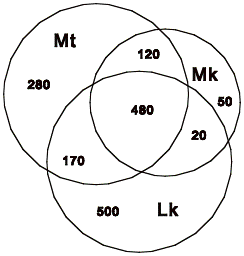
Allan Barr, A Diagram of SynopticRelationships,shows details of distribution.
2) By the sections used for the Eusebian Canons (Lists).
| Canon | Content | # Entries |
| 1 | All 4 | 74 |
| 2 | 3 Synoptics | 111 |
| 3 | Mt/Lk/Jn | 22 |
| 4 | Mt/Mk/Jn | 25 |
| 5 | Mt/Lk | 82 |
| 6 | Mt/Mk | 47 |
| 7 | Mt/Jn | 7 |
| 8 | Lk/Mk | 13 |
| 9 | Lk/Jn | 21 |
| 10a | Matthew | 62 |
| 10b | Mark | 19 |
| 10c | Luke | 72 |
| 10d | John | 96 |
.
Eusebiansections are often rather small. The books are divided into the following number of sections each:Matthew (155), Mark (233), Luke (342), John (232).
TheEusebian Canons are 13 lists designed to help one find parallel passages in theother Gospels. They can be found in the front of the various editions of theNestle-Aland Novum Testamentum Graece.
Letus look at some phenomena of overlap and uniqueness of content for all fourGospels as revealed by a careful look at the canon table above.
2possible combinations do not actually appear in these lists:
Notecanons 2-4, passages which occur in exactly three Gospels.
Notecanons 5-9, passages which occur in exactly two Gospels.
3) Summary of overlap.
This is Q in the 2‑document theory.
This is mainly discourse material, with only 1narrative (temptation of Jesus).
Something of the problem was recognized as soonas the second Gospel began to circulate, probably in the 60's.
Opponents of Xy used the Gospels against eachother to attack Christianity, e.g., Celsus' True Account
Heretical attacks motivated Christians to tryand solve the synoptic problem. Herewe sketch some such attempts:
a. Tatian's Diatessaron
Tatian prepared a "woven" harmony,taking all the accounts and editing them into a single narrative.
b. The Canons of Eusebius (before 340)
Eusebius used Ammonius' divisions to make thelists (canons) noted above. Thetables index parallel accounts, making study of these accounts mucheasier.
c. Augustine, Harmony of the Evangelists
Augustine made the first attempt to go incident-by-incidentthrough the Gospels and suggest how to harmonize them.
He is also the first to suggest a theory on howsynoptics arose, a version of the successive dependence theory (on which morelater), in which Matt was written first, Mark condensed it, and Luke used bothin writing his Gospel.
Augustine's theory: Mt ==> Mk ==> L
About this time military & economic disasterstruck the Roman Empire. Literacyfell drastically (from perhaps 80% to 5%) between 300 to 500.
d. Reformation Harmonies
With the resumption of academic biblical studiesin the Renaissance and Reformation, attempts to harmonize resumed,rethinking the sort of work Augustine had done. The problem was faced of how to decide when to treat twosimilar events as the same or different, with widely divergent solutions.
We continue with more recent theories, from the1780's to present.
e. The Urevangelium (primitive Gospel)
Proposed independently by Lessing and Eichhorn
|
|
There was one original Gospel.
Similarities between Synoptics are due to all 3using Ur as source.
Differences arise as they edit and translateUr differently.
f. Successive Dependence
Proposedby Augustine,
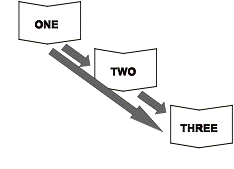
revived by Grotius.
Idea: /1/ is written,
/2/ uses /1/ when writing his,
/3/ uses both /1/ and /2/.
In most versions, /2/ or /3/ may
use other oral or written sources
besides previous Gospel(s) also.
These were very popular in the 19th century;
every possible order was suggested at that
time (see Thiessen or Alford).
Is still used today by some, e.g.:
Augustinian Mt ==> Mk ==> Lk
Griesbach Mt ==> Lk==> Mk
|
|
g. Fragmentary
Proposed by Friedrich Schleiermacher,"father" of modern liberalism.
Were many written fragments ("shortaccounts", not "parts of mss") of anecdotes, parables, discourses,miracle accounts, short stories, etc., which the Gospel writersstrung together into a continuous narrative.
Similarities between Gospels explained by usingsame fragments, differences by using different fragments or differenteditions of same fragments.
|
|
h. Oral Tradition
Proposed by Westcott and Alford, who arerelatively conservative.
The common basis of the Synoptics isentirely oral.