45thAnnual Meeting
EvangelicalTheological Society
TheMcLean Hilton, Tysons Corner, VA
18Nov 1993, 2:30 PM
PRESENTINGTHE GOSPEL
TOTHOSE WHO REJECT SCRIPTURE
RobertC. Newman[1]
![]()
Abstract: Presenting the Gospel isfairly straightforward when your audience consists of those who know andaccept Scripture, but even in the U.S. many do not fall into this category. Some who accept (but don't know)Scripture won't believe your message without careful study on their own,and even then they may well be inclined to reject the testimony of Scripturerather than believe what it says about themselves. But Paul has left us an example ofbeing all things to all men, that he might by all means save some. When he spoke to those who knew Scripture,he used Scripture. When he spoketo those who did not, he didn't use Scripture. How can we present the Gospel in a believable way tothose who do not view the Bible as God's Word?
![]()
Much of the evangelistic activity of theChristian church today C particularly in the U.S. Cis centered on presenting the Gospel to those who already know and acceptScripture. At least this is theimpression one gets from the popular evangelistic methods currently in use.
Consider the "Four SpiritualLaws" booklet distributed by Campus Crusade.[2] This popular sixteen-page bookletpresents the Gospel in a series of four laws, followed by an invitation toreceive Christ. If a profession ismade, the materials provided at the end of the booklet give the person assuranceand get him or her started in growth. Each of the four laws is supported by two to four brief Scripturecitations. Bible quotations arealso given for the material on assurance and discipleship.
Another popular Gospel presentation isthat used by Evangelism Explosion and briefly summarized in the booklet"Do You Know for Sure?"[3] To answer the question why God shouldlet you into his heaven, the tract responds, "Did you know that the Bibletells you how you can KNOW FOR SURE that you have eternal life and will go tobe with God in heaven?" Eachof the five following points is buttressed by one to four Scripture quotations. As with the "Four SpiritualLaws," short Biblical quotations are given for the sections oncommitment, assurance and Christian growth. Thus both these presentations assume that the readeraccepts the Bible as God's Word.
| 
1 |
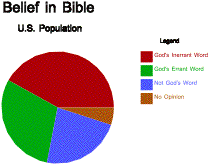
This is not unreasonable when oneconsiders that an unusually large fraction of the U.S. population says itbelieves the Bible is God's Word. The Gallup publication Religion in America found 72% of the U.S. populationmaking such an affirmation in a poll taken in 1984.[4]
Yet many of these do not know what theBible says, since their acquaintance with Scripture is only piecemeal and atsecond hand, perhaps from very unreliable sources. A similar poll in 1982 showed that,while 70% knew where Jesus had been born (which every Christmas pageanttells us), only 46% could name all four Gospels and only 42% knew who deliveredthe Sermon on the Mount.[5] In spite of this widespread ignorance,we praise God that some of these will accept the Gospel when we tell them whatit says. There are probably manythousands in the U.S. and millions throughout the world who havenever clearly heard God's offer of free pardon, who yet by his grace will makean immediate decision when they do hear it.
Others will not accept immediately Cperhaps due to the large variety of religions in the world today, or to themany charlatans around with quick-fix messages C but they will later turn to Christ afterthey learn for themselves what the Bible says. These can often be won through longer-term evangelisticBible studies.
| 
2 |
On the other hand, others who currentlyaccept Scripture will later reject it when they find out what it really says.[6] They will prefer their own views andlifestyle to those taught by Scripture, which they formerly thought werethe same.
And besides those who accept Scripture,there are large numbers in the U.S. who reject it. Some 5% deny the existence of any God or UniversalSpirit, and only 66% believe in a personal God who watches over and judgespeople.[7] Some 23% do not believe the Bibleto be God's Word and 30% believe it is sometimes mistaken, so less than halfeven profess to believe whatever it says.[8] And some additional percentage(probably a substantial number) would move into this position ifpressed by the claims of Jesus and the Gospel.[9]
How can we present the Gospel to suchpeople who reject Scripture? That is what we want to consider here.
The Example of Paul:
The apostle Paul has set us an example inhis evangelistic work on how to present the Gospel to quite diverseaudiences.
To those knowing Scripture, Paulmade use of this knowledge in pressing the claims of Christ. In the synagogue at Antioch of Pisidiaon his first missionary journey (Acts 13:16-41), Paul spoke to Jews who hadbeen raised in the knowledge of God's Word, to proselytes and Godfearers who hadconsiderable exposure to Scripture, and probably to other Gentiles who were atleast sufficiently interested in the God of Israel to come to synagogue tolearn what the Bible teaches. HerePaul sketched the history of Israel, making use of numerous biblicalallusions, and quoting from Ps 2:7, Isa 55:3, Ps 16:10, and Hab 1:5. Where his audience knows and acceptsScripture, Paul does not hesitate to use it. Yet even with Bible-believing audiences, the apostle doesnot expect them to take his word without checking it out. He argues with the Jews in Damascus(Acts 9:22) that Jesus is the Messiah promised in Scripture. And those in Berea (Acts 17:11) arecommended for testing Paul's message by the Bible.
But to those not knowing Scripture, Pauldoes not assume such knowledge. Nor does he expect his listeners to take his word on faith either. In the market place at Lystra, where anaudience of pagan Gentiles gathered at news of a spectacular healing, Paul(Acts 14:15-17) calls their attention to the creator God as seen in naturethrough his gifts of rain, crops, food, and joy. Though God has previously let the Gentiles go their own way,he has now sent Barnabas and Paul to call them to turn from their worthlessidolatry and serve the living (i.e., the real) God. In the more sophisticated climate at Athens, Paulargues with the pagan philosophers and gains an opportunity for a hearingbefore the court of the Areopagus. Here Paul notes (Acts 17:22-31) that the Athenian worship is deficientbecause the creator God needs nothing from us, but instead he gives useverything. God made ushumans to seek him, and he is not far away, as quotations from the paganauthors Epimenides and Aratus illustrate. God previously overlooked idolatry but now commands repentance, hasset a day of judgment, and appointed Jesus as judge by raising him from thedead. In these two examples we seethat, with pagans, educated or not, Paul appeals to such knowledge of Godas they have, plus the evidence of what God has recently done by intervening inhistory through Jesus.
Besides these examples, Paul elsewheretells us his guiding principles in evangelization. In 1 Cor 9:19-23 he urges the believers at Corinth to giveup their own selfish attitudes, stop being stumbling blocks, and reach out toothers. Though the Corinthians'major problem seems to have been getting along with each other in thecongregation, Paul's illustration concerns outreach to the unsaved:
ThoughI am free and belong to no man, I make myself a slave to everyone, to win asmany as possible. To the Jews Ibecame like a Jew, to win the Jews. To those under the law I became like one under the law... so as to winthose under the law. To those nothaving the law I became like one not having the law... so as to win those nothaving the law. To the weak Ibecame weak, to win the weak. Ihave become all things to all men so that by all possible means I might savesome. I do all this for the sakeof the gospel, that I may share in its blessings.
Paul's example suggests that we shouldnot expect the unsaved to come looking for us (though perhaps they ought to,and some will), and that we should not expect them already to accept Scriptureor hold orthodox doctrines. It isup to us to put ourselves out and go where they are and find them, not onlygeographically, but also linguistically, culturally, ideologically,methodologically and emotionally, at the same time not compromisingthe Gospel itself.
Some Approaches to Those Who RejectScripture:
There are doubtless a number ofapproaches we can make to those who do not already accept the Bible as God'sWord. Most of these will beaudience-dependent in one way or another, just as Paul indicates in 1 Corinthians9 above. An approach to Muslimswill differ in many ways from one to Buddhists or secular humanists. And an approach to liberal,sophisticated Muslims would probably differ from one to their less educatedbrethren.
Since many today profess to be atheistsor agnostics, it is not unreasonable to present evidence for the existence ofGod, without worrying too much whether they really are atheists. This approach might take a philosophical form to reach thosewho have some training or interest in philosophy,[10]though the fraction of people today that fit in this category is apparentlyrather small.[11] Since science is highly regardedin modern culture, the rapidly growing evidence for God's existence beinguncovered by scientific investigation will probably have a greater impacton larger numbers, though here too the number of people who are scientificallyliterate is small.[12]
There are many more in our society andespecially around the world who believe God exists, yet who do not identify himwith the God of the Bible. Forthese, it may be most effective to present the claims of Christianity incontrast to other religions[13]and to give evidence for the truth of Scripture.[14]
Some in our society accept the truth ofparts of the Bible, but not those which seem unreasonable to them. These may be helped by responding tothe things which trouble them[15]and by presenting the claims of Jesus and evidence for his resurrection.[16]
All these approaches can be very helpfulto remove stumbling blocks that keep many from coming to Christ. They can also encourage Christians,giving them more confidence in the truth of Christianity and thedefensibility of the Bible, particularly as many believers have beenbadgered into silence by the intellectual arrogance of skeptics. In addition, this material can be helpfulin stopping the mouths of opponents,[17]who often seem to think (and certainly teach) that Christians are ignorant,gullible people who are afraid to face the truth.
But all these methods will be fruitlessif the person is not inclined to listen. A friend of mine who was an atheist until well into adulthood was onceasked how he would have reacted in earlier years to some evidence I had justpresented. His responsewas, "I would never have gone to a talk of that sort"! Others may not be inclined to listenbecause for them Christianity is just one of many religions clamoring forattention. Or because theyknow Christianity would interfere with their preferred lifestyle. And many others already have a religionwhich satisfies them.
How can we incline a person tolisten? Ultimately we can't. Only God can finally do this. Sometimes he uses disaster in aperson's life, or some other incident that does not involve believers. But God often lets us share in drawingothers to himself, sometimes by friendships, sometimes by the unsavedperson observing our lifestyle when we don't even know it. Just as a preacher cannotguarantee his congregation will listen to the sermon, neither can we guaranteea hearing from the unsaved. Butjust as a preacher can do some things to make it more likely the congregationwill listen, so can we as evangelists. We need to work on reaching out to where people are asregards interests, education and intellect in order to be more effective.
One approach used effectively incenturies past deserves more attention than it is currently getting, especiallygiven the great interest today in psychology and self-help. This approach is to help people seethat they really are sinners and that this is a very serious problem indeed. In pointing out the problem of humansin, we must not merely communicate on the level that this is what God says, sotake it or leave it. The audiencemay just take this as evidence that the Bible is not God's word after all. Too many in our society are alreadyturned off by evangelicals preaching against sin as though weourselves have licked the problem, when it is obvious to the unsaved thatwe haven't. Talk about an unconvincingargument! We need rather topresent the biblical teaching on sin in such a way that it is clearlytrue, not just to those who already accept Scripture, but to those who don't.
G. K. Chesterton once said that originalsin is the only doctrine of Christianity which can really be proved.[18] Without endorsing Chesterton's claimthat it is the only such doctrine, we can make use of the sort of evidence hehad in mind. An excellentpresentation along these lines using the research findings ofmodern psychology has been given by David G. Myers of Hope College.[19]
In spite of the popularity ofthe "self-esteem" movement and its claim that the main human problemis too low an opinion of ourselves, Myers notes that research psychologistshave amassed a "powerful river of evidence" that exactly theopposite is true, that we most commonly have an unrealistically good opinion ofourselves. Myers sketches sixlines of evidence for this:
1. We tend toaccept much more responsibility for our successes than for our failures,which are typically seen as bad luck or someone else's fault.
2. Most of usview ourselves as above average in any particular good trait, and a largepercentage of us put ourselves in the very highest percentiles.
3. When wecannot deny that we did a particularly nasty thing, we are usually quite goodat justifying it.
4. We commonlyoverestimate the accuracy of our judgments and the truth of our beliefs.
5. Most of usare unrealistically optimistic in remembering and reporting information aboutourselves, and in predicting how well we will do in life.
6. Weconsistently overestimate how virtuously we would act in hypotheticalsituations compared with how we actually act in real ones.
Although Myers does not list it withthese six, another feature he notes is also relevant:
7. Depressedpeople are typically more accurate in their self-appraisal and more likely tosee themselves as others see them.
Such materials might be very helpful ingetting people to see that their own evaluation of their attitudes andperformance may not be a realistic picture of how God views them.
A related matter which is also importantin presenting the Gospel to those who do not accept Scripture is the need toremove stumbling blocks they have picked up along the way. Many in our culture (even in thechurch) have distorted ideas about the Gospel which tend to obscure its messageor make it look arbitrary. Wemust be very careful to keep in mind and convey to our listeners that God isjust, that He hates sin, and will not allow sin to go unpunished, and thathe couldn't be a good God if this were not so.
Some years ago I came across a salvationtract which illustrates this problem in a distressing way.[20] The tract starts out by describingthe all-too-common practice of getting a traffic ticket "fixed." If you know the right people at CityHall, it said, you can avoid paying the fine. They will "take care of it" for you. Similarly, the tract went on, if youknow God, He too will rescue you from the penalty for your sins. God forbid! Here we have twisted the free grace of God into crookedpolitics! No wonder some peopledespise the Gospel! Scripturetells us again and again that God does not practice favoritism and we must noteither (Acts 10:34; Rom 2:11; Eph 6:9; Col 3:25; 1 Tim 5:21; Jas 2:1,9; Ex23:3; Lev 19:15; Gen 18:25).
The biblical teaching about hell isanother big stumbling block to most unbelievers. In seeking to remove stumbling blocks, we have no right toevaporate or dilute Scripture, but we must also be careful not to exaggeratewhat it says either. Many peopleseem to think that hell is the "great torture chamber in the sky" (orrather, under the earth), where Satan and his demons are busy concoctingtorments for the damned. This hasbeen the occasion for some opponents to compare God unfavorably with Hitler andsimilar characters. Scriptureis clear (so it seems to me)[21]that hell will last forever and that it is decidedly unpleasant, but thismust be presented as consistent with God's justice. No one will get what they don't deserve. A helpful suggestion made yearsago by Charles Butler arises from the parable of the rich man and Lazarus. The rich man is pictured ascontinuing to sin (in thought and words) after he has died. Perhaps, then, the eternal punishmentof hell is not an infinite punishment for a finite series of sins committedduring our life on earth, but rather an infinite series of finitepunishments which match the infinite series of finite sins we will continue tocommit in hell since we have rejected God's offer of pardon.[22]
This brings up another common stumblingblock C what about those who have neverheard? For many, this is theclearest indication that Christianity is really arbitrary and that theChristian picture of God is that of one who is unjust. I suggest that we Christians have notdone the best we could in defending God on this point, being more like Job'sthree friends than we ought to be.
There is, of course, the problem ofchildren who die very young, before they are old enough to understand the Gospel. I do not intend to address thisquestion, except to point out that (in another context) God himself feels theforce of Abraham's plea, "Shall not the God of all the earth doright?" and He will vindicate himself at the judgment. However, none of us (and none of ouraudience bringing such objections) fall into this category, and Godsometimes chooses not to answer questions that don't concern us directly, justas Jesus would not answer Peter's question about what would happen to John(John 21:19-23).
As for people who are old enough tounderstand the Gospel, what about those who have never heard? If I understand Scripture properly, there aren't any! All have experienced God's generalrevelation. God has revealed innature that He exists, that He is good, and that He is powerful.[23] In our consciences, God has also revealedthat He exists, that He is good, and that we aren't.[24] We are thus in bad trouble! We can cast ourselves on God formercy, asking Him to forgive us and rescue us from our sin, even though (apartfrom Scripture) we have no guarantee he will do so.[25] God could only forgive us on the basisof Jesus' work in paying for sin on the cross. How much do we need to know about Jesus to get saved? I don't know; perhaps nothing. The Scripture certainly seems toindicate that people were saved before Jesus came, and not just those who wereIsraelites.[26] Of course, God would not have given theNew Testament revelation if it were not needed, but we should notassume that God has arbitrarily made changes in the way of salvation overthe course of human history. Inany case, it is clear that we must not be depending upon our own goodness, forthat is not good enough, as even our own conscience witnesses. Nor should we depend on the assuranceof various unauthorized teachers, whether professing Christians orrepresentatives of other religions.[27] And we certainly must not bepresuming upon God's forgiveness even as we continue going our own way in sinand rebellion, for God is just and he will by no means clear the guilty.
Conclusions:
A perennial problem the Church has facedthrough this century is the loss of so many of its children when they go awayto college. Some, of course, arejust maturing and beginning to make their own decisions now that they are nolonger under the supervision of their parents. Many such will decide to go their own way, especially if aneasy out is provided by the classroom instruction and moral climate of the schoolthey attend. Others, unfortunately,are not adequately prepared to face the challenges they encounter there, eventhough they would like to remain in the Church. I felt myself in something of this situation when I wentaway to Duke University out of a "moderate" Southern Baptist churchjust outside Washington, DC.
This is a great shame when Christianityhas such powerful evidences for its truth that impact directly on everyday,observable life. But theChurch has all too easily fallen into a ghetto or fortress mentality,[28]trying to keep their flock from contact with unbelief rather than training themto effectively impact the unbelievers around them.
We as apologists, theologians, teachers,and pastors need to help our people see where the facts really lie andencourage them to live redemptive lives in full contact with the unsaved.
References:
[1]. Director,Interdisciplinary Biblical Research Institute (POB 423, Hatfield, PA19440-0423); Professor of New Testament, Biblical Theological Seminary(200 N. Main St., Hatfield, PA 19440).
[2]. Bill Bright, HaveYou Heard of the Four Spiritual Laws? (San Bernardino, CA: Campus Crusade, 1965; recent reprint, n.d.).
[3]. Do You Know forSure?(Fort Lauderdale, FL: EvangelismExplosion III International, 1989).
[4]. "Religion inAmerica: 50 Years: 1935-1985," The Gallup Report 236 (May, 1985):47.
[6]. Of the 72% whobelieve the Bible is the Word of God, 30% believe it is sometimesmistaken. Ibid., p. 47.
[7]. Ibid., p. 50. From a 1981 poll.
[9]. Probably in thiscategory are a significant fraction of the children raised in Christian homeswho abandon the faith when they leave home. Note how many of the Jews following Jesus left him when theybegan to understand what he was really teaching (John 6:60-71).
[10]. Some philosophicalpresentations: R. C. Sproul, JohnGerstner, and Arthur Lindsley, Classical Apologetics (Grand Rapids:Academie/Zondervan, 1984; I still find the ontological argument unconvincing);Norman L. Geisler and William D. Watkins, Worlds Apart: A Handbook onWorldviews, 2nd ed. (Grand Rapids: Baker, 1989).
[11]. The StatisticalAbstract of the United States (1987) has a total of 263 thousand receivingundergraduate degrees in the sciences, math and engineering for the year1984, against only 12 thousand in philosophy, religion and theology. The fraction of people in the U.S.with any significant training in philosophy is thus rather small, since the 5%of college grads above must have those in religion and theology removed andthen be multiplied by the 21.4% of people who have completed college (WorldAlmanac 1993, p. 191). Thus probablyless than 1% have significant education in philosophy.
[12]. Some scientificarguments: Hugh Ross, TheCreator and the Cosmos (Colorado Springs, CO: Navpress, 1993); Hugh Ross, TheFingerprint of God, 2nd ed. (Orange, CA: Promise, 1991).
[13]. Claims ofChristianity vis a vis other religions: Colin Chapman, Christianity on Trial (Wheaton: TyndaleHouse, 1975); Harold Netland, Dissonant Voices: Religious Pluralism and theQuestion of Truth (Grand Rapids: Eerdmans, 1991).
[14]. Evidence for thetruth of Scripture: John W.Montgomery, ed., Evidence for Faith: Deciding the God Question (Dallas, TX:Probe/Word, 1991); Robert C. Newman, ed., The Evidence of Prophecy (Hatfield, PA:IBRI, 1988); S. I. McMillen and David E. Stern, None of These Diseases, rev. ed. (OldTappan, NJ: Revell, 1984); Kenny Barfield, Why the Bible is Number 1: TheWorld's Sacred Religions in the Light of Science (Grand Rapids:Baker, 1988); William Campbell, The Qur'an and the Bible in the Light ofHistory and Science (Middle East Resources, 1992).
[15]. Responding toobjections: See Gleason L. Archer, Encyclopedia of Bible Difficulties (Grand Rapids:Zondervan, 1982); Norman Geisler and Thomas Howe, When Critics Ask: APopular Handbook of Bible Difficulties (Wheaton, IL: Victor Books, 1992). Many objections are more fundamentalthan those discussed in these works; for such see C. S. Lewis, God in theDock(Grand Rapids: Eerdmans, 1970) and Norman L. Geisler and Ronald M. Brooks, WhenSkeptics Ask: A Handbook of Christian Evidences (Wheaton, IL:Victor Books, 1990).
[16]. Evidence for theclaims of Jesus and for his resurrection: Craig Blomberg, The Historical Reliability of the Gospels (DownersGrove, IL: Inter-Varsity, 1987); Josh McDowell and Bill Wilson, He WalkedAmong Us: Evidence for the Historical Jesus (San Bernardino, CA: Here's Life,1988); Norman L. Geisler, Miracles and the Modern Mind (Grand Rapids:Baker, 1992); John Wenham, Easter Enigma: Are the Resurrection Accounts inConflict? (Grand Rapids: Academie/Zondervan, 1984); Gary Habermas and AntonyFlew, Did Jesus Rise from the Dead? (San Francisco: Harper and Row, 1987).
[17]. As Christianleaders are instructed to do in Titus 1:9.
[18]. Gilbert K.Chesterton, Orthodoxy (New York: Dodd, Mead and Co., 1936), p. 24; his wholechapter 2 "The Maniac" is impressive.
[19]. David G. Myers,"The Inflated Self," Christian Century (1 Dec 82): 1226-1230;see also his book The Inflated Self: Human Illusions and the BiblicalCall to Hope (Harper and Row, 1980).
[20]. I no longer have acopy of this tract. Even if I did,I am not sure it would be charitable to name its publisher!
[21]. Larry Dixon, TheOther Side of the Good News: Confronting the Contemporary Challenges to Jesus'Teaching on Hell (Bridgepoint/ Victor, 1992).
[22]. Though not totallysatisfactory in some points, C. S. Lewis' book The Great Divorce (Macmillan, 1978)captures something of this.
[23]. See references innote 12.
[24]. See reference innote 19, above; also C. S. Lewis, Mere Christianity (Macmillan, 1952),part I: "Right and Wrong as a Clue to the Meaning of the Universe."
[25]. Compare thereaction of the Ninevites to Jonah's preaching, Jon 3:9: "Who knows? God may yet relent and with compassionturn from his fierce anger so that we will not perish."
[26]. Job, Melchizedek,Moses' father-in-law?
[27]. It would beinteresting to analyse the world's religions as Satan's countermoves againstwhat was known of the Gospel at that time and place where each particularreligion originated.
[28]. See the trenchantremarks along these lines in Michael Bauman, Pilgrim Theology: Taking the Path of Theological Discovery (Grand Rapids:Baker, 1992).