Robert C. Newman Library
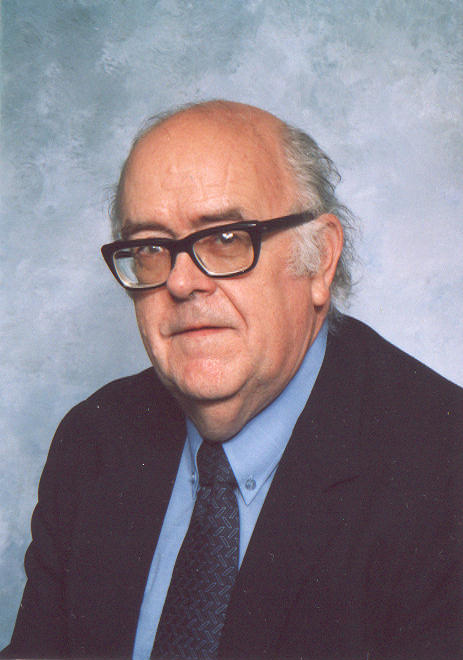
Robert C. Newman (2003)
| Biography Robert C. Newman is Emeritus
Professor of New Testament at Biblical Theological Seminary, Hatfield,
Pennsylvania, and Director of the Interdisciplinary Biblical Research
Institute. His doctorate is in theoretical astrophysics from
Cornell University, and he has a M.Div. from Faith Theological
Seminary, and an S.T.M. in Old Testament from Biblical Theological
Seminary. He has done additional graduate work in cosmic gas
dynamics at the University of Wisconsin, in religious thought at the
University of Pennsylvania, in hermeneutics and biblical interpretation
at Westminster Theological Seminary, and in biblical geography at the
Institute for Holy Land Studies (now Jerusalem University College).
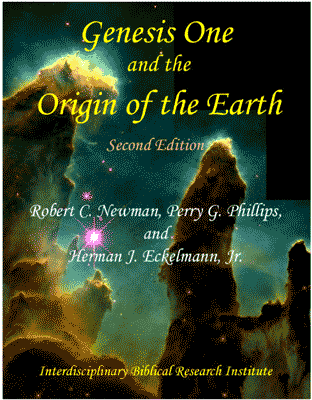
He is a past President of the Evangelical Theological Society, a professional society of nearly 3000 theologians. He has done scientific research for the U.S. Weather Bureau and the Franklin Institute. He is a fellow of the American Scientific Affiliation, a society of some 2500 Christians in the sciences, a member of the editorial board of its journal Perspectives on Science and Christian Faith, and was formerly Chairman of its Commission on Creation. He is coauthor of Genesis One and the Origin of the Earth (InterVarsity Press, 1977, 2007), editor of The Evidence of Prophecy (IBRI, 1988), and a contributor to Youngblood, The Genesis Debate (Nelson, 1986); Kantzer and Henry, Evangelical Affirmations (Zondervan, 1990); Montgomery, Evidence for Faith (Probe/Word, 1991); Bauman, Hall, and Newman, Evangelical Apologetics (Christian Publications, 1996); Habermas and Geivett, In Defense of Miracles (InterVarsity Press, 1997); van Gemeren, New International Dictionary of Old Testament Theology and Exegesis (Zondervan, 1997); Dembski, Mere Creation: Faith, Science and Intelligent Design (InterVarsity Press, 1998); Evans and Porter, Dictionary of New Testament Background (InterVarsity Press, 2000); Newman, Wiester, Moneymaker and Moneymaker, What’s Darwin Got to Do with It? (InterVarsity Press, 2000); and Brasher, Encyclopedia of Fundamentalism (Routledge, 2001). He is also author of The BiblicalFirmament: Vault or Vapor? (IBRI, 2000) and of articles in The Astrophysical Journal, Planetary and Space Science, Perspectives on Science and Christian Faith, The Westminster Theological Journal, Grace Theological Journal, Concordia Journal, Presbyterion, The Journal of the Evangelical Theological Society, and Philosophia Christi. He is a frequent speaker at churches and colleges on evidences for the truth of Christianity and on the interaction between science and the Bible. He has been on TV on several occasions, including guest appear¬ances on the programs "700 Club," "100 Huntley Street" and the A&E network program "Mysteries of the Bible." Dr. Newman is a native of Arlington, Virginia, and a resi¬dent of North Garden, Virginia. |

Books
hi-resolution
Research Reports by Robert C. Newman
| RR#01 |
The Biblical
Narratives of Easter Week: Are They Trustworthy? The
positive side of a debate at Cornell
University
(the whole debate is here: part 1 part 2 ). Arguments against the
miraculous
examined;
NT documents compared with other ancient histories; corroboration with
pagan and Jewish authors. (1980)
Chinese Translation (Traditional)  Chinese Translation (Simplified)  French Translation Les Récits Bibliques d e la Semaine de Pâques: Sont-ils Fiables? German Translation Die Biblischen Erzählungen Der Osterwoche: Sind Sie Glaubwürdig? Russian Translation  |
| RR#02 |
The Synoptic
Problem:
A Proposal for Handling Both Internal and External Evidence The
positive side of a debate
at Cornell University
(whole
debate is on cassette #IRN-02). Arguments against the miraculous
examined;
NT documents compared with other ancient histories; corroboration with
pagan and Jewish authors. (1990 rev.)
|
| RR#03 |
Demystifying
the Controversy over the Textus Receptus and the King James Version of
the Bible. with Douglas S. Chinn. The main arguments used by TR-KJV proponents are seen to be fallacious; the KJV and TR suffer from the same "problems'' as the Alexandrian text and its modern translations. Some factors lying behind the heated advocacy of the TR-KJV are suggested. (1990 rev.) |
| RR#06 |
The New Testament
Model of the Messiah. Various attempts
were made in the centuries following the completion of
the Old Testament to understand its teachings regarding the coming
Messiah.
Models constructed by the rabbis, the sect at Qumran, the writers of
the
apocalyptic literature and the New Testament are here compared with the
Old Testament data to show the striking superiority of the NT model in
fitting certain paradoxical features. (1988 rev.)
Chinese Translation (Traditional) Note: The htm is jpeg images and does not require a
Chinese font.
Acrobat PDF version Microsoft Word Version. Chinese Translation (Simplified) Note: The htm is jpeg images and does not require a
Chinese font.
Acrobat PDF version Microsoft Word Version.
French Translation Les
Modèle
du Messie Présenté dans le Nouveau Testament
|
| RR#09 |
Various attempts
were made in the centuries following the completion of
the Old Testament to understand its teachings regarding the coming
Messiah.
Models constructed by the rabbis, the sect at Qumran, the writers of
the
apocalyptic literature and the New Testament are here compared with the
Old Testament data to show the striking superiority of the NT model in
fitting certain paradoxical features. (1988 rev.)
French Translation Le
Temps du Messie [.pdf
format] Traduit de l'americain par
Sophie
Thiery.
German
Translation Die Zeit des
Messias Les sources historiques des deux premiers siècles de notre ère indiquent qu'à cette époque, l'attente du retour du Messie s'appuyait sur une prophétie de l'Ancien Testament, probablement Daniel 9:24-27. Le calcul classique de Sir Robert Anderson, qui s'appuie sur ce passage, soulève de sérieux problèmes. Mais il existe une alternative si les <<semaines>> sont interprétées comme étant en fait des cycles d'années sabbatiques. Russian Translation 
Spanish Translation La Era Del Mesías [.pdf format] Las fuentes historicas de los dos primeros siglos de la era cristiana indican que este fué un período en el que se anticipaba el cumplimiento de algunas profecías del Antiguo Testamento, en particular la de Daniel 9:24-27. Los cálculos clásicos de Sir Robert Anderson presentan dificultades serias, pero estas pueden resolverse interpretando las “semanas” de esta profecía como los siete años del ciclo sabático del Antiguo Testamento. El resultado señala a Jesús como el cumplimiento de esta profecía. |
| RR#13 |
The Council of
Jamnia and the Canon of the Old Testament Liberal
critics theorize that a council held about AD 90 completed the
canonization of the Old Testament. Talmudic evidence is surveyed, and
no
evidence is found for such a council or for binding canonical decisions
then. Rather a consensus on the content of the OT existed in the first
century AD which was already ancient. (1983)
|
| RR#15 |
A Critical
Examination of Modern Cosmological Theories Basic
scientific data on the nature of the universe are presented: the
structure and energy sources of stars, stellar distances, Olber's
paradox,
galaxies and their redshifts, cosmic distance scales, quasars, and the
three-degree blackbody radiation. Various cosmologies, both secular and
Christian, are tested by this data. (1982)
|
| RR#19 |
A
Critique of Carl Sagan's TV Series and Book "Cosmos" Related Lecture. Sagan's 'Cosmos' is evangelism for secular humanism. His treatment of Christianity is critiqued, as are his oscillating big-bang cosmology and naturalistic view of the origin of life. There is evidence for making a rational choice between worldviews. (1984) |
| RR#21 |
Some Perspectives
on
the Image of God in Man from Biblical Theology Using
Vern Poythress' perspectival hermeneutics
(Symphonic
Theology, 1987), we see that man as created in God's image is taught in
hundreds of Biblical passages rather than just the few which use the
words
"image" or "likeness." An exciting approach for presenting doctrinal
theology to laymen.
(1984)
|
| RR#23 |
Evolution-Religion and the Genesis Account Related Lecture In McLean vs Arkansas
leaders of several mainline denominations opposed
teaching creation in public schools. We suggest this opposition was
theological
since these leaders advocate an evolu tion-religion known as
theological
liberalism. Liberalism's treatment of the Genesis account is sketched,
as are evidences this approach is mistaken.
|
| RR#24 |
The Return of
Christ:
Interpreting Revelation by its Allusions Revelation is the most difficult
book
in the NT, yet it is filled with OT allusions which are especially
helpful in understanding it. The use of such allusions for
interpretation is illustrated in Rev. 19:11-21. These allusions, plus
other contextual considerations, support a premillennial eschatology.
|
| RR#35 |
Synoptic
Harmonization: Some Principles from History and the Book of Acts Problems in harmonizing
parallel
passages
are often raised against inerrancy in Scripture. Here, principles from
history and history writing, and parallel passages in a single author
suggest
why and how we should harmonize. (1987)
|
| RR#36 |
Self-Reproducing
Automata and the Origin of Life Related
lecture. The minimal
complexity for life is considered, assuming that living
things
are merely self-reproducing automata. Mathematical models for such
automata
are briefly reviewed, and Langton's very simple model is described in
detail.
The complexity of his automaton suggests that life is designed rather
than
accidental. (1987)
German translation: SICH SELBST-REPRODUZIERENDES AUTOMATON UND DER URSPRUNG DES LEBENS pdf document Unter der Annahme, daß das einfachste Lebewesen ein sich selbst reproduzierendes Automaton darstellt, wird die kleinste Komplexi tät untersucht, die für Leben notwendig ist. Es werden in kurzer Form die Arbeiten von von Neumann, Codd und Langton vorgestellt, wobei Langtons äußerst einfaches sich selbst-reproduzierendes Automaton im einzelnen beschrieben wird. Die Komplexität von Langtons Automaton weist stark darauf hin, daß Leben nicht zufäl lig entstanden ist, sondern vielmehr einem Plan entspringt. |
| RR#37 |
The Status of Evolution as a Scientific Theory with John Bloom, Perry Phillips and John Studenroth. Evolution is frequently called a fact by its proponents. Here various common definitions of "evolution'' are considered, and the evidential status of each is evaluated. (1990) |
| RR#39 |
Jesus: The
Testimony
of Prophecy and History Several Old
Testament prophecies about the Messiah are examined. It is
suggested that: (1) if the Messiah has come he is Jesus; (2) the
Messiah
has come. (1990)
|
| RR#56 |
Rumors of Angels: Using ID to Detect Malevolent Spiritual Agents. Audio. Most discussions of God's action in nature since about 1900 have ignored angelic activity, perhaps in reaction to White's History of the Warfare of Science with Theology in Christendom. Here we take another look at the biblical data on angels, and then consider what scientific data might be relevant in the light of recent interest in intelligent design (2005). |



Audio Lectures by Robert C. Newman
|
HOW YOU CAN HELP TO IMPROVE THIS WEBSITE You may help to improve this website by providing us with outllines or transcriptions of these audio lectures -- and by correcting or annotating the existing outlines in the lecture series. Please send any such material by e-mail to Input to IBRI. |
Lectures on The Epistles of Peter: 01 02 03 04 05 06 07
Lectures on Revelation, Chapter by Chapter: 01 02 03 04 05 06 07
Lectures on The Gospel as History: 01 02 03 04 05
Interdisciplinary Model-Making: 01 02 03
Powerpoint Lectures by Robert C. Newman
These Lectures have been updated to include audio lectures.
There are over 170 lectures in full.
Additional lectures can be found in the Da Vinci Code Series.
Papers by Robert C. Newman
| The
Ancient Exegesis of Genesis 6:2, 4 |
|
| Evangelicals and
Crackpot Science (1994) |
|
| Evangelicals and
Modern Science (1990) |
|
| Evidence for the
Christian Faith (2006) |
|
|
The Gospel of Judas (2006) |
|
|
The Star of Bethlehem: A Natural-Supernatural Hybrid? (2001) The Life of Jesus From Astronomy: A follow-up paper by Douglas Chinn (2022) |
|
|
Public
Theology and Scientific Method:
Formulating Reasons that Count Across Worldviews (2002) |
|
|
Public
Theology and Prophecy Data:
Factual Evidence that Counts for the Biblical Worldview (2002) |
Tracts by Robert C. Newman
|
Russian Version (pdf):
 |
|
| |
|
| |
|
| |
|
| |
|
The Tomb of Jesus (2007) |
Class Notes and Syllabi
Russia Seminar Talks: Seeker's Track (1991)
Dice or Deity Seminar (1988-1992)
Notes on The Gospel of Matthew (1994)
Acts & Pauline Epistles (1997)
Course Syllabus:
• Mediterranean Geography
• Chronology and Introductions to the New Testament Books
Course Notes on Hebrews (1999)
Lecture Notes on Inerrancy and the Synoptic Problem (1977). Audio.
Summer Theological Institute Lecture.
New Testament Backgrounds (1991)
Course Syllabus:
• History of Intertestament period
• NT geography and chronology
• NT Culture and archaeology.
The Synoptic Gospels (2005)
Course Syllabus:
• The Historical Jesus
• The Jewish Background
• Authorship and Date of the Synoptics
• Parables
• The Gospels as Literary Works
Alfred Edersheim, Messianic Passages in the Old Testament as Cited in Rabbinic Literature. Edited by Robert C. Newman
Other Documents
Talk Outlines
contact@ibri.org · Interdisciplinary Biblical Research Institute · Fair Use Disclaimer